In 1928, in his studio at the Dessau Bauhaus, Paul Klee set down a composition of roughly forty small quadrilaterals in warm and cool temperatures, arranged in uneven courses, and placed a single red circle above the top register. He called it Castle and Sun. The painting measures about fifty centimetres on its long side and lives today in private collection record. Read as a picture, it is a town at dusk. Read as a document of a teacher who ran the Bauhaus form classes from 1921 to 1931, it is something else: a finished canvas that still behaves like the first assignment he would have set his students that same week.
The 1928 Grid Is Not Decoration, It Is Coursework
By the year this painting was made, Klee had been at the school for seven years. He had arrived in Weimar in 1921, moved with the Bauhaus to Dessau in 1925, and would stay until 1931 before Düsseldorf pulled him away. He had sat beside Itten, then watched Albers take over the preliminary course and sharpen it. He had filled blackboards with the diagrams later gathered into the pedagogical sketchbook published in 1925. Castle and Sun is the shape those blackboards took when the chalk stopped and the tempera started.
Look at the surface the way a first-week student would have been asked to look at any composition brought in for the Monday critique. Count the courses: roughly nine horizontal registers from base to top edge. Count the units within them: between four and seven quadrilaterals per register, never the same count twice. Measure the units: no two have identical proportions. A near-square sits beside a narrow vertical. A squat trapezoid interrupts a row. The grid is strict about the horizontal register and lets everything else breathe.
This is not pattern work. It is the solution to a problem a form-class instructor would have stated in five words. Divide a rectangle. Hold a register. Make the divisions unequal. Balance each tile against its neighbour at the warm-cool axis. Do not flatten the plane with symmetry. Every student in the preliminary course was asked some version of this exercise within their first six weeks, and most of them produced grids that failed on at least one of those five counts. The common failures are easy to list. They repeat the same unit size and the composition goes dead. They alternate warm and cool in a checker and the field reads as tartan, not as a modulated plane. They centre the whole arrangement and lose the lateral tension that an off-balance horizontal grid is meant to produce.
Klee's painting makes none of these mistakes, because Klee was the person who had identified them. The tile widths drift. The warm and cool clusters pool rather than alternate — three or four warm tiles in a row, then a cool run, so the colour reads as geography rather than as texture. The courses are not stacked plumb; they sag slightly at the centre of some registers and lift at the edges of others, enough to feel hand-made but not enough to lose the horizontal grammar. We are watching a teacher solve his own homework. He is not showing off. He is demonstrating, at scale and in oil, what the correctly answered version of the brief looks like when a mature painter happens to be the one at the easel.
This is why the painting still reads as exercise even now, almost a century after it was made. Strip the title away and it belongs on the corridor wall between two student compositions. The difference is only that the examples around it would not be as calm.
The Red Circle Is the Argument the Grid Was Waiting For
A single red disk, placed above the top register, slightly off the vertical centreline. It occupies maybe five percent of the canvas surface. It carries most of the argument.
Kandinsky's questionnaire from around 1923 — distribute the three primaries, yellow, red and blue, among the triangle, the square and the circle — was still a live piece of discussion in Dessau when Castle and Sun was painted. Kandinsky's own answer was known to every student: yellow to the triangle, red to the square, blue to the circle. He published it. He defended it in lectures. He drew it on walls. Students pushed back; most of them thought red belonged to the circle because the sun is round and hot and nothing else on a Western palette behaves quite that way. Klee, in his own teaching notes, treated the question as a live problem rather than a settled one.
In this painting he answers it with a single gesture, and the answer is not Kandinsky's. Red goes to the circle. The square — the geometric rectangle that Kandinsky would have assigned red — is handled instead by the entire grid beneath, whose forty cool and warm tiles together perform the chromatic work Kandinsky wanted a single red plane to do. The circle, lifted free of the register and flooded with the hottest pigment on the palette, does the one thing the grid is structurally incapable of doing. It collapses the painting to a point.
This is what circles do, and it is why circles were treated at the school as the most dangerous of the three basic forms. A square shares the frame's own orientation and recedes politely into the architecture of the picture. A triangle points, and pointing is directional but at least it is contained by the edges of the triangle itself. A circle has no edges in the same sense. It cannot be aimed. It pulls the eye toward a centre, and once the eye is at that centre everything else in the picture becomes orbit. Klee knows this. He places the disk high and slightly off-centre precisely so the orbit is uneven, so the whole warm grid below is drawn up toward the disk without ever quite achieving symmetry with it.
The argument the painting is making is specific. It is not that Kandinsky was wrong about red and the square. It is that the question was posed at the wrong scale. Assign red to a single element and you are solving a logo. Assign red to a single element inside a field of forty temperature-balanced tiles and you are making a painting, because the single element now has a context to be an argument against. The grid is what makes the circle readable as the sun instead of readable as a dot.
Castle and Sun Is How the Bauhaus Taught You to See
The painting is not about a castle and it is not about a sun. The title is what the eye arrives at after the grid and the circle have already done the work. Read the warm quadrilaterals as masonry and a hill town appears at dusk. Read the red disk as a sun and the dusk is specified: late, low, nearly set behind the town. The representational reading is not imposed by the composition. It is permitted by it. The painting would hold together without any such reading at all; a viewer who had never seen a castle would still see a balanced warm-cool field anchored by a hovering red point, and the field would still feel complete.
This is the whole pedagogical claim of the preliminary course, compressed into fifty centimetres of canvas. Form carries meaning before image does. The grid is not a stylisation of masonry; masonry is one of several things a grid of warm quadrilaterals is allowed to evoke. The circle is not a stylisation of the sun; the sun is one of several things a single hot disk hovering above a warm register is permitted to suggest. The composition works bottom-up, from element to reading, never the other way round. A student who tried to paint Castle and Sun by starting with "a castle at dusk" and then finding shapes to fit the idea would produce a picture postcard. Klee started with the elements and let the picture earn its title in the last five minutes.
The lesson scales. Every composition the studio now generates by code begins the same way, at the level of unit, interval and primary colour. The title is the last thing that happens. Foundation — a modular grid of circles, arcs and bars in primary colour — is the preliminary-course exercise itself, set as a poster. Dessau Morning is a low sun rising over stacked horizontal bands, built register by register and then named only once the geometry was settled. Ascending Forms earns its title from the measured upward steps of its rectangles, not the other way around; and Archway lets its nested arcs behave like a gateway only because the arcs were solved first. When we work this way, representational readings arrive as gifts the composition gives the viewer, never as commissions the composition was taking orders from. Castle and Sun is the earliest, clearest version of that discipline we know of, and it is why the painting still reads as a teacher's demonstration rather than as a finished product. The whole shop, across every title, descends from what the grid and the red circle are doing on this one canvas. The entire catalogue at /shop/ is this exercise, continued.
A closing admission. This started as a note about where Castle and Sun sits in Klee's output and turned, somewhere around the second paragraph, into a reading of the painting as a teaching document rather than as a picture. We think the reading survives. A painter who teaches for ten years does not stop teaching when he picks up a brush, and the people who learned from him in Dessau would not have mistaken this canvas for anything else.
FAQ
When exactly did Klee paint Castle and Sun?
The painting is dated 1928, made during Klee's period teaching at the Dessau Bauhaus, which the school had occupied since its move from Weimar in 1925. Klee had joined the faculty in Weimar in 1921 and would leave Dessau for Düsseldorf in 1931, so 1928 falls almost exactly in the middle of his Bauhaus decade — late enough that his form-class pedagogy was fully developed, early enough that the school itself was still stable under Hannes Meyer's directorship.
What is the painting actually depicting?
On its most literal reading, a hill town at dusk with a setting sun. On its structural reading, a modulated grid of roughly forty warm and cool quadrilaterals arranged in nine horizontal courses, anchored by a single red circle floating above the top register. Both readings are correct. The representational reading is permitted by the geometric one, not the other way round, which is the point the painting is quietly making about how pictures should be built.
Was Klee responding to Kandinsky in this composition?
The two taught together at the Bauhaus throughout the 1920s, and Kandinsky's circulated questionnaire assigning red to the square, yellow to the triangle and blue to the circle was still an open argument in Dessau when Castle and Sun was made. Klee's placement of a single red disk — unmistakably a circle — reads as a deliberate counter-proposal. We would not go as far as calling it polemic. Klee was gentler than that. Call it a corrected answer, worked in oil.
Where is Castle and Sun today and can I see it?
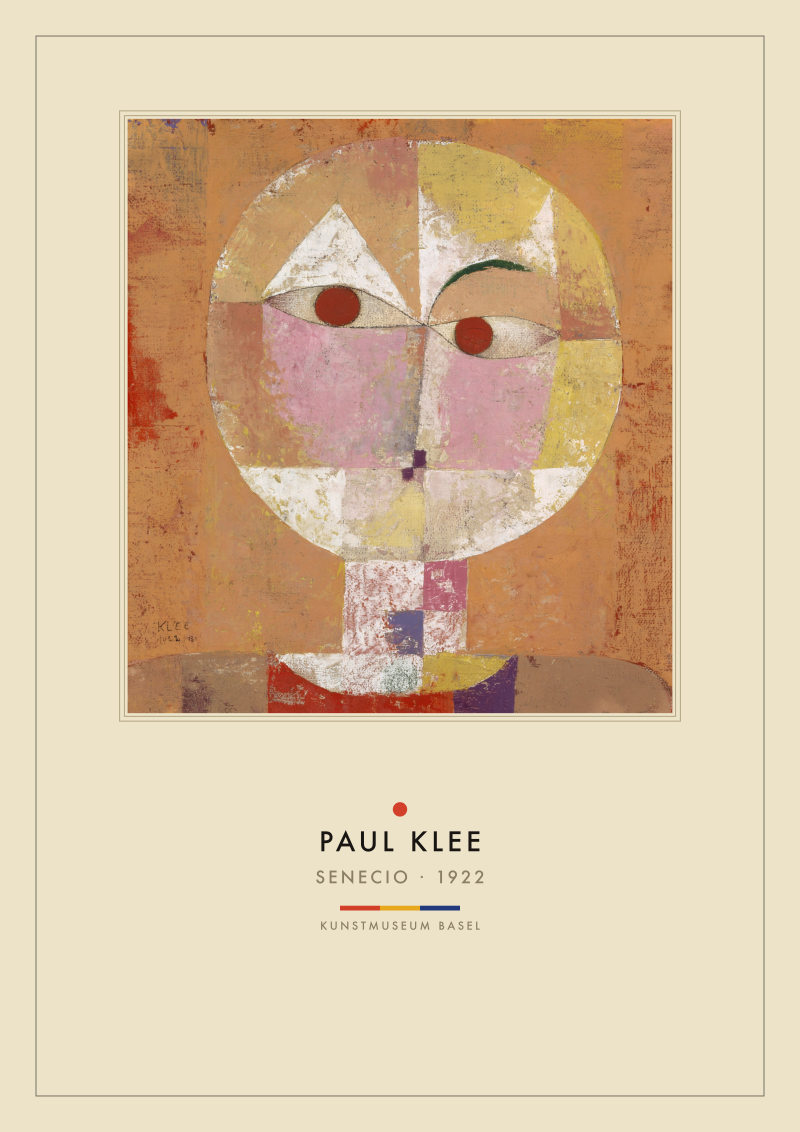
The work is held in private collection and appears periodically in major Klee retrospectives and Bauhaus-centenary exhibitions. It is not on permanent public display in a single museum the way Klee's Senecio (Basel) or Twittering Machine (New York, MoMA) are, which is part of why this particular painting is reproduced constantly in books and almost never seen at first hand. Catalogue reproductions tend to warm the red disk more than the canvas actually warrants.
Is the painting an abstract work or a figurative one?
Neither word fits comfortably, and that discomfort is exactly what the preliminary course was training students to produce. The composition is figurative enough to earn a title about a castle and a sun. It is abstract enough that removing the title would not damage the structural completeness of the image. Klee's generation at the Bauhaus taught that the dichotomy itself was a weak frame; a composition should be solved geometrically first and read representationally afterward, if at all.
What size is the original and does scale change how it reads?
The painting is roughly fifty centimetres on its long side — modest, closer to a reading book than to a wall painting. At that scale the grid reads as handled, almost intimate; you register the individual tile edges and the slight wobble of the registers. At reproduction scale — the postcard, the book plate, the screen — the grid flattens into something more decorative and the red circle grows comparatively louder. The painting was made to be approached, not projected.
How does Castle and Sun connect to the compositions your studio produces?
Everything we generate from a seed obeys the same order of operations Castle and Sun obeys. The geometric unit and its interval are settled first. The primary colours are distributed against a warm-cool balance before any representational reading is entertained. Titles arrive last, as acknowledgements of what the geometry already allowed. It is the preliminary-course discipline restated in code, which is why our catalogue sits comfortably in the same room as a 1928 Klee without apologising for the century between them.
From the collection
New compositions and 10% off your first print.
One email now with your code. No noise after.