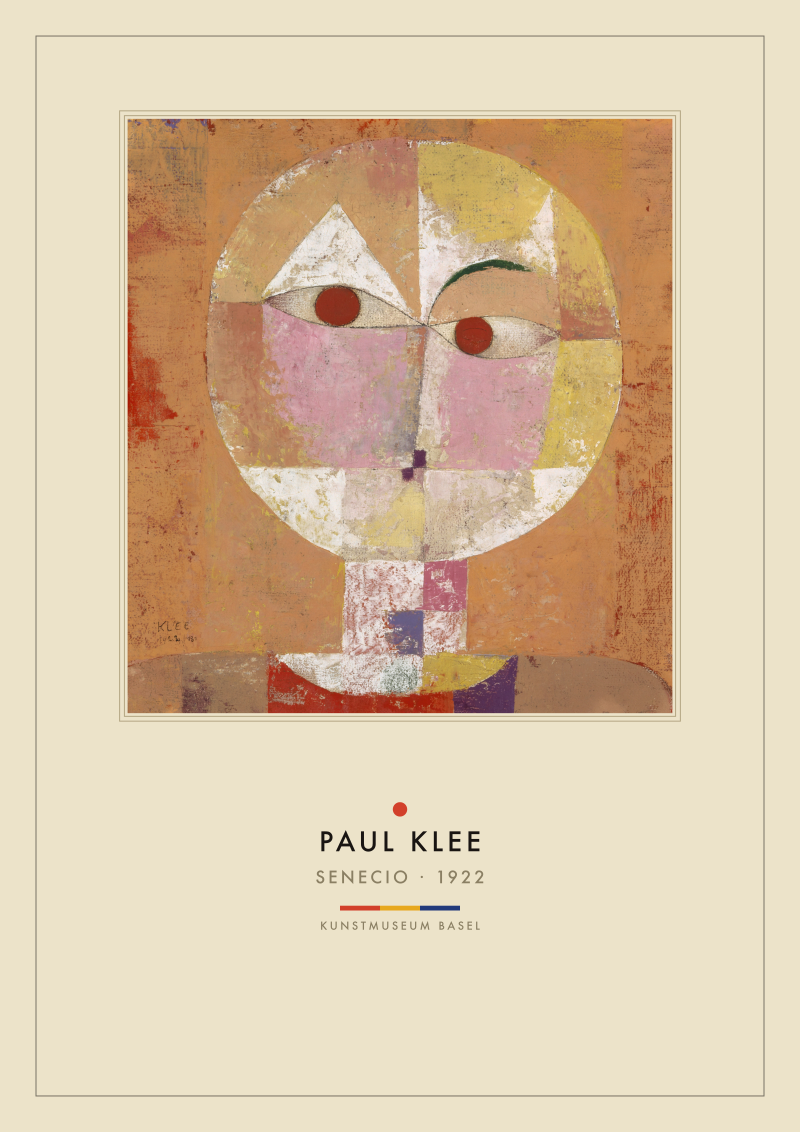
Paul Klee joined the Bauhaus in 1921, at Weimar, and stayed with the school through the move to Dessau in 1925. Somewhere in that span he made a small, quiet painting of a sun above a castle, and the reason we keep returning to it has less to do with what it depicts than with what it teaches. It is a painting made by a man who spent his working weeks explaining, to first-year students, how a circle differs from a square, and how a red differs from itself when you move it three centimetres to the left. Sun and Castle is that lesson, painted.
Klee Painted Sun and Castle While Teaching the Preliminary Course
To understand the panel you have to understand the timetable. Klee arrived in Weimar as a working painter with a reputation and left, fourteen years later when the school itself was gone, as a teacher whose notebooks would be studied longer than most of his contemporaries' finished work. The years in between were structured around the Bauhaus's own peculiar rhythm: workshops in the morning, form and colour classes in the afternoon, endless discussions in the evening about whether a triangle was a shape or a force. Klee taught form. That is a plain sentence and it hides a great deal.
The preliminary course, the Vorkurs, was the school's spine. Every student, whatever workshop they meant to end up in, spent their first two semesters in it, learning to see before they were allowed to make. Johannes Itten had built the course in Weimar; Josef Albers took its material discipline over when Itten left; Wassily Kandinsky and Klee ran the parallel form and colour classes that ran alongside it. The four names get shuffled together in the popular retelling into a single Bauhaus method, but the classes did not feel the same. Itten was mystical and rigorous at once. Albers taught by having students bend and cut and stack until the material told them what it wanted. Kandinsky drilled a strict geometry: the triangle was yellow, the square was red, the circle was blue, and if you did not agree, he wanted your reasoning in writing. Klee taught differently again. He taught the way a musician teaches — building up from the smallest unit, the point, and moving through line and plane the way a composer moves from note to phrase.
We say all this because Sun and Castle was made inside that daily practice. It is not a painting a man makes on a weekend, escaping his working life. It is a painting made by a teacher whose working life was thinking about how shapes signal. A circle sitting high in a frame is not a decorative choice. It is a decision about hierarchy — about which mark carries weight and which recedes, and about how a viewer's eye is walked from the top of a rectangle to the bottom without being told, in so many words, where to look.
Look at the castle in the painting and you can see the preliminary course inside it. The forms are stacked. There is a base, wider and heavier, and there are walls above it, and there are towers that break the upper line at intervals a student would have been asked to justify with a diagram. Everything is measured. Nothing is loose. The sun is not the small yellow dot a child paints at the corner of a landscape; it is a full geometric weight, placed carefully enough that removing it would collapse the composition. This is what it looks like when a form teacher paints.
The other detail worth marking is the light. Klee's palette in these Bauhaus years grew more disciplined without ever going flat. He was reading and re-reading colour theory, working through Delaunay and reaching his own conclusions, and he kept a set of watercolour studies going alongside his teaching notes that read now like private worksheets for the classes he was giving. A castle wall in one of these paintings is rarely a single colour. It is a colour sitting next to another colour, adjusting itself, warming or cooling depending on what it is placed against. Albers would formalise this later, in the classes he taught here and then, after 1933, in America. But the principle is already at work in Klee's small panels. Colour, in a Bauhaus painting, is not applied. It is arranged.
The Painting Is a Grammar of Shapes, Not a Picture of a Place
There is a version of this article that would want to identify a specific castle and a specific sun — to place the panel in a town Klee had visited, on a hill he had walked past, at an hour of the day the shadows suggest. We are not going to write that version. It would be a story about Klee's biography rather than about the painting, and it would miss what makes the panel useful to anyone still working in the tradition it belongs to. Sun and Castle is not a document of a place. It is a demonstration of how a small vocabulary of shapes, put in the right relations, can build a world.
Read the composition as grammar. A single circle. A stack of quadrilaterals that read together as a mass. A few thin verticals that break the top line into towers. That is almost all of it. A student in the preliminary course, given those pieces and asked to build a landscape, would produce dozens of variants, most of them worse. Klee's version works because the circle is placed slightly off-centre, because the horizontal bands beneath the castle carry the eye laterally before letting it climb, and because the towers are irregular in a way that feels earned rather than clumsy. Every one of those choices could be marked in red on a blackboard. Every one of them is teachable.
The Bauhaus's insistence that form has meaning independent of subject matter is what allowed a painting like this to be made without irony. A castle in a painting made in 1922 Germany, or 1925 Germany, or somewhere between, is not a nostalgia object. Klee is not lamenting a lost medieval world. He is using the castle the way a poet uses a familiar noun — because the reader will recognise it quickly, letting the real work of the sentence happen underneath. The real work is happening in the geometry. A triangle above a square feels different from a square above a triangle. A warm circle over a cool block reads as morning; the same circle in a cooler yellow reads as afternoon. These are not effects Klee is claiming to invent. They are effects he is naming, in paint, in a form his students could learn from.
The colour discipline is the second half of the grammar. Klee is quietly opinionated about how colours behave in company, and Sun and Castle is one of the paintings where the opinion is legible. The sun is not a hot yellow shouting from the top of the canvas. It is a warm mass that sits in a specific relation to the wall colour beneath it — close enough to belong to the same painting, distinct enough to hold its position. Move the sun down two centimetres and it becomes a lamp in a window. Cool it by fifteen per cent and it becomes a moon. Every one of these variants would still be a Klee. Only one of them is Sun and Castle, and the reason is arithmetic as much as it is intuition.
We put it plainly. The painting is a set of decisions, not a set of feelings. That is not to say it is unfeeling; it is to say the feeling arrives through the decisions rather than in spite of them. This is the Bauhaus position on how art works, and it is why the school produced painters and typographers and architects and weavers from what looked, from outside, like the same course.
What This Small Panel Still Tells a Studio Working by Code
We work in a studio that generates geometric compositions from seeds. A run of our own catalogue — Archway, its nested arcs rising from the base like a gateway, or Foundation, a modular grid of circles, arcs and bars in primary colour set as a poster — is a set of files produced by code, deterministic and reproducible, in a language Klee did not have. And yet the questions we ask when we look at a Klee are the same questions we ask when we tune a seed. Where does the eye enter the composition. Which mark is doing the structural work and which is doing the ornament. What happens if we cool this yellow, or shift this arc twelve degrees, or reduce this stack from five bars to three. The vocabulary is smaller than a beginner assumes and the choices are harder than a beginner assumes. That is the preliminary course, restated, still true.
There is a piece in our own catalogue called Dessau Morning: a low sun rises over stacked horizontal bands, quiet geometry in the warm palette of a workshop at dawn. It is not a reproduction of Sun and Castle, and we would not pretend otherwise. But it is a piece that could not exist without the century of teaching that Klee's panel sits inside. The sun in our composition is a decision about hierarchy in exactly the way Klee's is. The horizontal bands do the lateral work before the eye climbs, exactly as they do in the older painting. The palette is warm rather than hot, restrained rather than saturated, because that is what those bars can carry without buckling. If you want to see one working out on a wall, it and its neighbours live at our shop.
The larger lesson is one the studio returns to whenever a new seed produces something that looks correct but reads dead. Correctness is not enough. A composition that ticks every geometric box can still feel airless, and a composition that appears loose can be, under the surface, more disciplined than the version that looked strict. Klee's small panels are the reference we hold up against our own runs. A painting can be almost nothing — a circle, a stack of rectangles, a few verticals — and still hold a room. If it does not hold, the code is not wrong. The decisions are.
Ascending Forms, another of our compositions, is the honest statement of this. Rectangles climb the frame in measured steps; the piece is about proportion and upward movement and very little else. It works because the intervals are right. It stops working the moment we let a seed drift the intervals into a rhythm the eye reads as accidental. Klee would have seen the drift instantly. He would have circled two of the rectangles on a diagram and moved on to the next student. That is the standard we try to hold to, and Sun and Castle is one of the paintings that keeps the standard honest.
This piece started as an attempt to write a short caption for a single Klee panel and turned, on the second draft, into an argument about what a teaching practice looks like when you paint your own homework. That is a Bauhaus argument, not a Klee argument, and it is the argument the studio makes every time a new composition ships. Whether that continues to be the right argument as the tools get stranger — as generative systems produce more work in an afternoon than a school produced in a decade — is a separate question, and it is where the next essay in this desk begins.
From the collection
New compositions and 10% off your first print.
One email now with your code. No noise after.