There is a pattern we keep noticing when a room finally settles. The owner has moved the sofa three times, swapped two rugs, hung and rehung the same frame, and the wall still refuses to hold the room together. Then something flat, geometric, and quietly primary goes up — a stack of bands, a nested arc, a grid of circles — and the room stops arguing with itself. The school that taught this stance opened in Weimar in 1919, moved to Dessau in 1925, closed in Berlin in 1933, and lasted a total of fourteen years. A century on, its grammar still ends the fight.
The Pattern That Keeps Showing Up on Walls
We see it so often it has become diagnostic. A room is almost right. The furniture is chosen, the light is warm enough, the rug is the correct size by a quarter inch. What is wrong is the wall. The wall is doing nothing, or it is doing too much — a tourist landscape, a motivational slogan, a photograph the owner no longer looks at. The owner knows something is off and cannot name it. They are a decision short, and the decision is about form.
The compositions we produce in the studio are built from a short vocabulary — nested arcs, stacked rectangles, horizontal bands at measured intervals, modular grids of circles and bars — and they resolve the problem with surprising reliability. *Archway* sends concentric bands up from the baseline like a gateway. *Ascending Forms* climbs the frame in deliberate rectangles, a lesson in proportion printed large. *Dessau Morning* banks horizontal strata under a low sun. *Foundation* lays out a modular grid of circles, arcs and bars in primary colour — the first exercise every student at the school was asked to confront, set here as a poster. None of these were invented for a specific sofa. They work because the school worked out the grammar first, and the grammar was more honest than the furniture under it.
The pattern is not about taste. It is about what a flat shape is allowed to do once you stop asking it to be a window. The Bauhaus answered that question with evidence rather than argument, and the answer still holds in 2026 because nobody has produced a more useful one.
Fourteen Years, Three Cities, One Argument About Form
The school's official life was shorter than most of the design movements it influenced. Walter Gropius founded it in Weimar in 1919, in the first chaotic months of the Weimar Republic, as a merger of a fine-art academy and a school of applied arts. The merger was itself the thesis — that the division between artist and craftsman, inherited from the nineteenth century, was no longer useful. In 1925, political pressure in Weimar made the school's position untenable and it moved to Dessau, where Gropius designed a new building that is still studied as the clearest built statement the Bauhaus ever made. In 1932 the Dessau school was closed and the Bauhaus relocated to Berlin as a private institution under Mies van der Rohe. In 1933 it closed for the final time under pressure from the new regime. From founding to closure, fourteen years. From Weimar to the end of Berlin, three cities.
What survived that short run is almost disproportionate to its duration. Part of the reason is that the closure scattered the faculty across the Atlantic. Josef Albers went to Black Mountain College and then Yale. László Moholy-Nagy went to Chicago and founded what became the Institute of Design. Mies went to Chicago too, and reshaped a generation of American architecture. The school had taught, among other things, how to teach — and the teaching travelled better than any single object the workshops produced.
The argument underneath the three cities was consistent across all fourteen years, even when the leadership and the pedagogy shifted. It was that form has to earn its place; that colour and shape have measurable behaviours; that an honest object answers to use before it answers to style; that geometry is not decoration but structure. This argument is why the shapes still work on a wall a hundred years later. The furniture dates. The architecture dates. The grammar does not.
The Preliminary Course Did the Work Nobody Credits
Before a student at the Bauhaus could enter a specialised workshop — weaving, metal, cabinet-making, typography — they were required to pass a preliminary course that stripped them back to materials, textures, colours, and basic forms. Johannes Itten built the first version of it. Albers and Moholy-Nagy rebuilt it later. Under all three, the course did the same thing: it refused to let a student make anything representational until they had understood what a circle, a square and a triangle actually do; what red next to blue actually does; what weight a diagonal carries that a horizontal cannot.
This is the part of the Bauhaus story that gets the least attention outside design schools, and it is the part that explains why the compositions still land. The preliminary course was not a warm-up. It was the entire philosophy, delivered as practice. If you worked through it honestly you emerged convinced that abstraction is not a style but a way of seeing, and that any applied object — a chair, a lamp, a textile, a poster — benefits from being designed by someone who has done the seeing first.
The Bauhaus is important because it taught, at an industrial scale, that geometry is literacy — and literacy outlives the century it was taught in.
The compositions we generate are not re-creations of specific student exercises. They are the preliminary course continued by code — the same vocabulary of arc, circle, bar, band, rectangle, with a deterministic seed replacing the student's hand. *Foundation* is explicit about this lineage; it is laid out as a poster of the exercise itself. The others are quieter about it, but they draw from the same drawer. When one of them calms a room, what is doing the work is the stance the preliminary course trained — the belief that a flat shape in the right place on a wall is already enough.
A Circle, a Square, a Triangle, and a Grid That Would Not Die
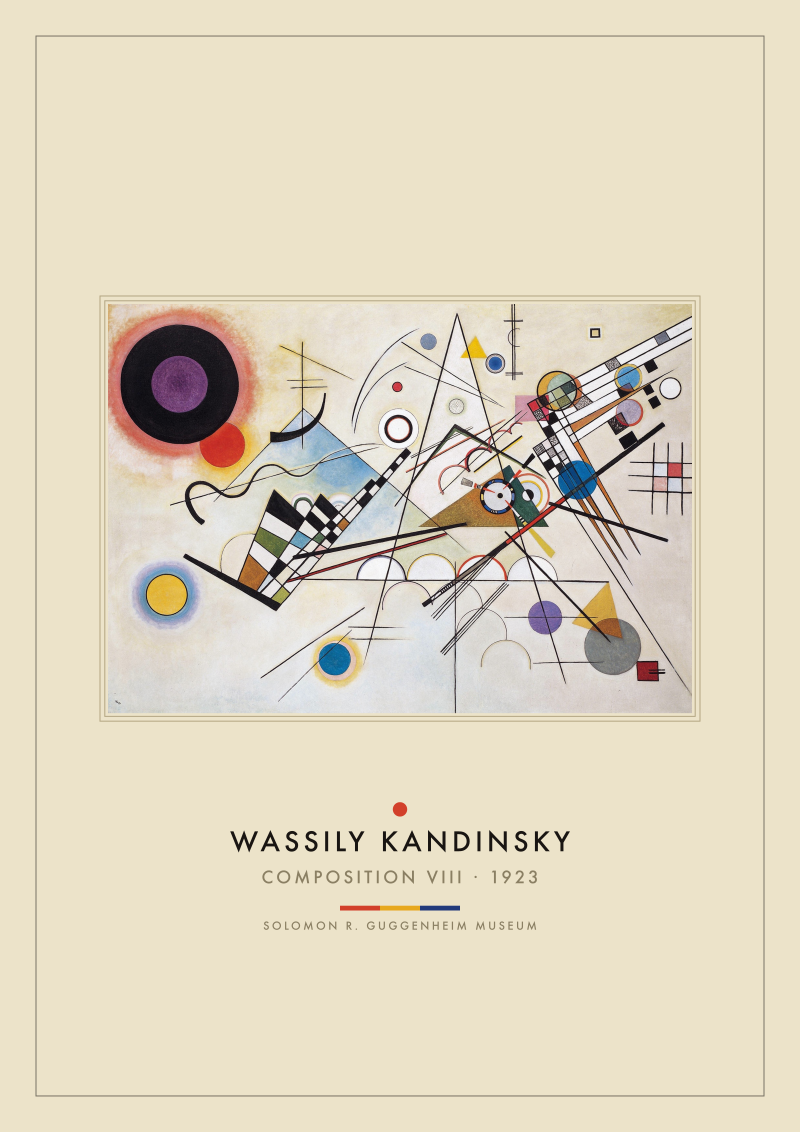
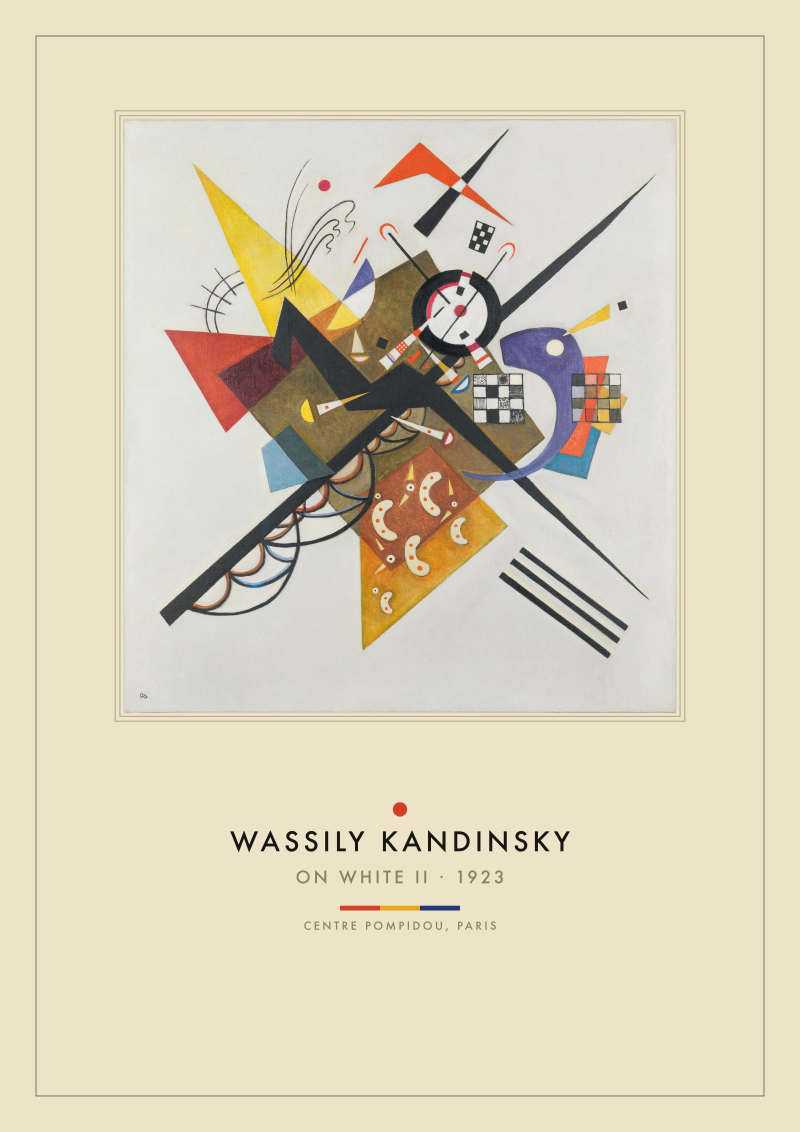
Among the specific ideas the school produced, one has outlived almost everything else. Early in the Weimar years, Kandinsky began associating the three primary forms — the triangle, the square and the circle — with the three primary colours — yellow, red and blue. He went so far as to circulate a questionnaire asking students and visitors which colour belonged to which form. The point was not to arrive at a correct answer. The point was to insist that colour and form have behaviours worth arguing about.
The questionnaire is treated now as a historical curiosity, and it would be, except that the pairing refused to die. It appears in children's furniture, in educational toys, in interface design, in branding systems, in gallery didactics, in half the poster shops in Europe. Any time you see a primary-coloured triangle, square and circle together, you are looking at a descendant of that questionnaire — usually without the designer knowing. The pairing survived because it is one of the few design propositions that is both strong and testable. You can disagree with Kandinsky's answer. You cannot disagree that the question is useful.
The grid behaved the same way. The Bauhaus did not invent the grid, but it argued more clearly than anyone else that a grid is not a cage; it is a floor. A grid gives shapes a reason to be where they are, and the reason is not personal taste. *Foundation* is a direct grandchild of that argument — modular, primary, non-hierarchical, legible from across a room. A century of graphic design has tried to escape the grid and keeps returning to it, because the alternative is a wall that cannot be read.
A diagonal, a horizontal and a vertical do not do the same work on a surface. A diagonal moves. A horizontal rests. A vertical rises. *Ascending Forms* uses the vertical to carry the eye up the frame in measured steps. *Dessau Morning* uses the horizontal to settle the frame into warm, stacked quiet. *Archway* uses nested arcs — closer to the vertical than the horizontal — to send energy upward from a baseline. These are not aesthetic preferences. They are the properties of flat form, documented, taught, and still true.
So What Do You Actually Do
Walk into your room at a time of day you do not usually use it — a Tuesday morning, a Sunday afternoon — and look at the wall you have been fighting with. Ask what the wall is currently being asked to do. Hold the room together. Give the eye somewhere to rest. Carry an edge that the sofa and the window do not finish. Most of the time, the wall is being asked to do structural work that the current image on it is not built to carry. A photograph of a beach is not a structural element. A composition in flat primary form is.
Then ask what shape the room wants. If the furniture is low and horizontal, give the wall horizontal bands — something in the register of *Dessau Morning* will reinforce the line without competing with it. If the ceiling is high and the frame feels empty vertically, use upward movement — *Ascending Forms* or *Archway* will carry the eye up and finish the room. If the space is child-adjacent, communal, or taught in — a studio, a classroom, a kitchen that doubles as homework table — put the preliminary course itself on the wall. *Foundation* is the compact form of the whole argument and reads instantly to anyone in the room, including people who do not care about design.
Finally, buy one, hang it, and leave it alone. The Bauhaus mistake, repeated by well-meaning owners for a century, is to over-decorate once the geometry starts working. The compositions in our shop are built to be the quiet decision in a room, not another loud one. Hang the piece, move the lamp back where it was, and let the wall do the work it has been trying to do since you moved in. If the room settles, which it usually does, the fourteen years of the school and the hundred years since have paid out their last and most domestic dividend: a wall that finally knows what it is for.
FAQ
Why do people still call the Bauhaus the most important design school ever?
Because it compressed, into fourteen years, a working argument that art and craft belonged in the same workshop, that geometry was literacy, and that an object's form should answer to its use. It then exported that argument through its faculty — Albers, Moholy-Nagy, Mies and others — into American education and architecture after 1933. The school's physical output was modest. Its pedagogical reach was not, which is why it still frames conversations about modernism in 2026.
Did the Bauhaus actually last only fourteen years?
Yes. It opened in Weimar in 1919, moved to Dessau in 1925 under political pressure, relocated to Berlin as a smaller private institution in 1932, and closed under pressure from the new regime in 1933. Three cities, three directors — Gropius, Hannes Meyer, Mies van der Rohe — and fourteen years from founding to closure. Its influence after 1933 came largely from émigré faculty teaching in the United States and elsewhere, not from the institution itself continuing.
What was the preliminary course and why does it matter now?
The preliminary course, or *Vorkurs*, was a mandatory first-year programme that every incoming student had to pass before entering a specialised workshop. Itten built the first version; Albers and Moholy-Nagy later rebuilt it. It trained students in materials, colour, texture and basic form — before any representational work was allowed. It matters now because the same vocabulary of circle, square, triangle, bar and grid still underpins readable visual design, whether on a wall, a screen or a page.
Did Kandinsky really link primary colours to primary shapes?
Yes. Early in the Weimar period Kandinsky associated yellow with the triangle, red with the square, and blue with the circle, and circulated a questionnaire asking others to confirm or disagree. The pairing was never a scientific result; it was a provocation. It survived anyway because it gave designers a durable way to argue about how colour and form behave together, and the vocabulary still turns up in branding, education and interior design today.
How is a generative composition related to the Bauhaus tradition?
A generative composition built from a deterministic seed and a short vocabulary — arcs, circles, bars, bands, rectangles — is the preliminary course continued by code. Instead of a student's hand making formal decisions inside the vocabulary, a program makes them, repeatably, from a seed. The lineage is pedagogical rather than imitative. The output honours the stance the school taught: that geometry is enough, and that a flat shape in the right place does real work.
Where does the phrase "form follows function" fit into this?
That phrase comes from the American architect Louis Sullivan, not the Bauhaus, and it predates the school by decades. It fits the Bauhaus argument because the school consistently refused ornament that could not justify itself by use. But crediting the slogan to the Bauhaus is a common confusion worth correcting. The school's own language was less tidy and more tested — it preferred working objects over mottos.
Does Bauhaus-style wall art only work in minimalist rooms?
No. It works in dense rooms too, and sometimes better there. A room full of warm clutter, textiles, books and mismatched wood benefits from a single geometric wall decision because the composition gives the eye a place to rest without adding to the complexity. The failure mode is pairing a Bauhaus composition with other loud graphic statements on nearby walls — the grammar is designed to be the quiet, resolving element, not a competing voice.
What is the one thing the Bauhaus got genuinely wrong?
It underestimated how people actually live in rooms. The school's furniture and interior proposals often prioritised legible form over the small, warm, inefficient habits of domestic life — reading in bad light, eating on a sofa, leaving things where they land. Later modernism inherited this blind spot and sometimes produced houses that photographed better than they lived. The grammar on the walls still works. The dogma about how the room beneath it must behave does not.
From the collection
New compositions and 10% off your first print.
One email now with your code. No noise after.