In 1919 the Bauhaus manifesto opened admission to any person of good repute, without regard to age or sex. Within a year, the school's internal rules rerouted almost every woman who arrived toward the weaving workshop, and left architecture and metal to the men. The women went anyway. They ran looms, mastered the workshops, and photographed the buildings the world would later recognise as modernism itself. The history books, when they mention them at all, tend to file them under textiles. This piece is our attempt to move a handful of those names back onto the ground floor.
Gropius Wrote Equality Into the Manifesto and Weaving Into the Timetable
The Weimar manifesto of April 1919 is remembered for the Feininger woodcut on the cover and for the sentence about building the cathedral of the future. It is less often quoted for the admissions promise that came a few lines later: any person of good repute, of any age, of either sex. Gropius signed his name to that. In the first semester the school admitted more women than men, a fact that surprised almost every commentator at the time and would go on to embarrass the school's own administration.
Then the masters met.
Within a year, the Council of Masters had introduced a second gate placed after Itten's preliminary course, at which women who had completed the same foundation as the men were routinely directed toward the weaving workshop. The metal, architecture and cabinetmaking shops were treated as unsuitable for female students on grounds that were dressed up in the language of aptitude but read, in the minutes, as the language of convenience. Weaving already existed as a workshop. Weaving already had looms. Weaving would not require Gropius to argue with any of his masters about a woman on their bench.
The women arrived anyway. Gunta Stölzl came in 1919, took the preliminary course, and by 1927 was running the weaving workshop as its first female master at Dessau — and, as it turned out, the only woman ever appointed to that rank at the school. Marianne Brandt fought her way into the metal workshop under Moholy-Nagy in 1924 and, within two years, was designing the tea infusers and desk lamps that would become the Bauhaus's clearest commercial hits. Anni Albers, who wanted to study painting, was directed to the loom and did not stop working in fibre for the next sixty years. Lucia Moholy, already married to Moholy-Nagy, moved through the school in an in-between status and became its principal photographer without ever being counted as a full student.
The story that gets told is a story about the manifesto's promise. The story that needs telling is what happened after the promise met the timetable.
The Weaving Workshop Was the School's Most Commercial Success and Its Most Ignored
By the late Dessau years, the weaving workshop was generating more licensing income than any other department in the school. This is the figure that ought to reframe everything the Bauhaus said about itself. Chair prototypes and metalwork got the exhibition catalogues, but it was fabric — upholstery weaves, wall hangings, industrial textiles licensed to firms across Germany — that paid a meaningful share of Dessau's operating shortfall in the years before the closure.
Stölzl inherited a workshop that had been treated as a holding pen and rebuilt it into an industrial design laboratory. Under her direction, weaving stopped being wall art and started being product. She brought in synthetic fibres, developed light-fast dyeing protocols, and negotiated licensing contracts with textile manufacturers who treated the workshop like a design consultancy. She trained her students to think about warp counts and washing tolerances the way the cabinetmakers thought about joinery. The finished fabrics went into offices, cinemas and ship interiors. They also went, in the archive that later historians inherited, into a drawer marked handicraft.
This is where the historiography breaks. Chairs by Breuer and lamps by Brandt sit in every design museum's twentieth-century room as furniture, unqualified. Fabrics by Stölzl, Otti Berger, Benita Koch-Otte and Anni Albers appear in the same museums, more often than not, in the textile department — a floor away, a different curator, a different budget for research. The intellectual work is identical. The classification is not. Design history was written by curators who inherited a nineteenth-century hierarchy in which furniture was industry and cloth was craft, and the Bauhaus women got sorted by the older ladder rather than the one the school itself was trying to build.
Marianne Brandt is the counter-example that proves the pattern. Because she worked in metal — because she took over the metal workshop as acting director in the late 1920s, because her lamps and tea services entered the same production line as the chairs — she is remembered as a Bauhaus designer with no adjective in front. Her name sits with Breuer and Wagenfeld in the standard survey. The women who ran the loom rooms, whose commercial output was larger, sit on a different page under a different heading.
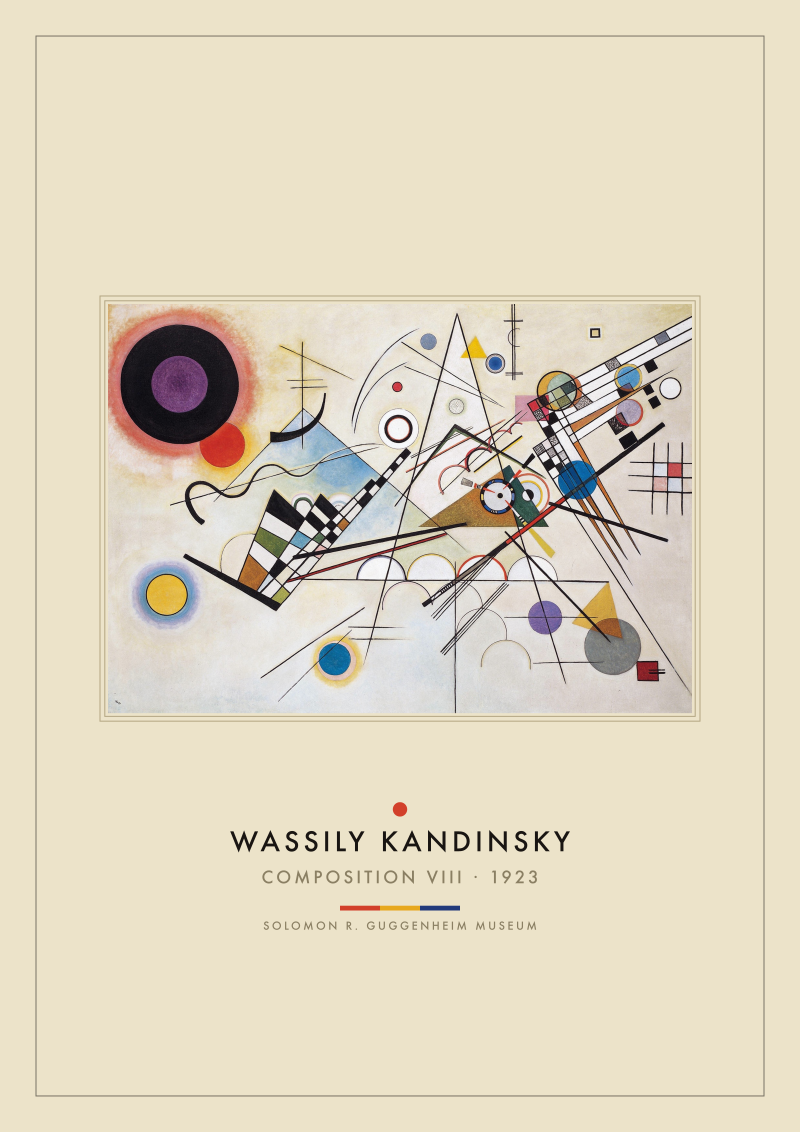
The loom was a grid. That is the sentence the historiography needed and did not use. The modular, calculable, ratio-driven grid was the whole intellectual bloodstream of the school. Foundation, one of the compositions in our own studio's shop, is essentially that argument set on a wall: a modular grid of circles, arcs and bars in primary colour, the exercise every preliminary student began with, held as a poster. What the weaving workshop did all day, at scale, in wool, was Foundation running horizontally.
Lucia Moholy Photographed the Bauhaus Into History and Was Cropped Out of It
Almost every photograph you have ever seen of the Dessau building — the corner where the glass curtain meets the workshop wing, the balconies of the studio block seen from below, the interior of the director's office with the Breuer chair in it — was taken by Lucia Moholy in the mid-to-late 1920s. She produced, by the reckoning of the Bauhaus-Archiv in Berlin, several hundred negatives documenting the buildings, the workshops, the products and the students. Those images are the reason the Dessau building exists in the visual memory of twentieth-century architecture. Without them, the school would have travelled far less well.
When the school was shut down in Berlin in 1933 and its files were at risk of confiscation, Moholy left the negatives with Gropius for safekeeping. She left Germany, taught in England, later worked for UNESCO. Gropius took the negatives with him to the United States. Over the next two decades he published book after book — the collected Bauhaus, the design surveys, the retrospective exhibitions at MoMA — using her photographs, uncredited, as the visual argument for his own leadership. Moholy discovered this after the war, opening a Gropius monograph and recognising her own negatives on plate after plate under someone else's copyright.
She spent years trying to get them back. Gropius, in the correspondence that survives, was evasive; his position appears to have been that the negatives were now part of the historical record and therefore, in some undefined way, no longer hers alone. She recovered most of them in the mid-1950s, after threatening legal action. She never fully got the credit back. The standard bibliography of Bauhaus photography, well into the 1980s, listed her images as anonymous or attributed them to the school as an institution.
The cropping was literal and it was also metaphorical. The literal version: her name was left off captions. The metaphorical version: the school's official narrative — the one Gropius wrote, the one the American museums translated into English — treated the women of the Bauhaus as ancillary. The masters made the ideas. The women made the fabric, the photographs, the meals, the wives-of. This was not a truth about the Bauhaus. It was a truth about who was writing about it in the 1950s and, for a long time, who was doing the writing since.
Contemporary scholarship — the work of Anja Baumhoff, T'ai Smith and Elizabeth Otto in particular — has been steadily undoing the cropping. The centenary in 2019 produced the first serious wave of exhibitions in which Stölzl, Brandt, Berger, Koch-Otte, Moholy, Albers and Ise Frank were treated not as an addendum but as principal actors. This is welcome and it is late. The building in Dessau went up in 1926. It took the historiography almost a century to caption the photographs correctly.
This started as a note-to-self about why the Bauhaus book on our studio shelf mentions three women in an index of a hundred names, and turned into something we did not expect: a story less about individual biographies and more about how classification works, who does it, and what it costs. We have not covered Ise Frank's editorial role at the Bauhaus press, though it deserves its own essay; we have not covered the Jewish and communist women of the school whose lives after 1933 are their own history entirely; and we have not touched the difficult question of what the school's American afterlife at Black Mountain and IIT did to further sort these names by gender. Each is a separate argument. This one was the first door.
From the collection
New compositions and 10% off your first print.
One email now with your code. No noise after.