Red is the square. Yellow is the triangle. Blue is the circle. The Bauhaus taught this pairing with the calm of a physicist stating a law, and generations of design students left the school repeating it as one. The claim traces to a questionnaire Wassily Kandinsky circulated among staff and students at the Weimar workshops in 1923, asking each to match three primaries to three basic forms. The returned answers were less unanimous than legend now records — yet the rule stuck, printed on posters, painted on walls, and folded into the foundation exercise every first-year began with. What follows is how that answer arrived, was tested, and outlived the school that produced it.
1919: Weimar and the Claim That Colour Belonged to Form
The school opened in Weimar in the spring of 1919 with a manifesto that placed craft above fine art and asked its students to unlearn the academy before they learned anything else. The building was inherited, the workshops were half-empty, and the first-year exercises were run by Johannes Itten, whose preliminary course did more to shape the school's early identity than any of the studios he sat above. Itten's classroom was where colour first stopped being decoration and started being a variable — an element that could be catalogued, contrasted and tested against form the way a chemist tests a reagent.
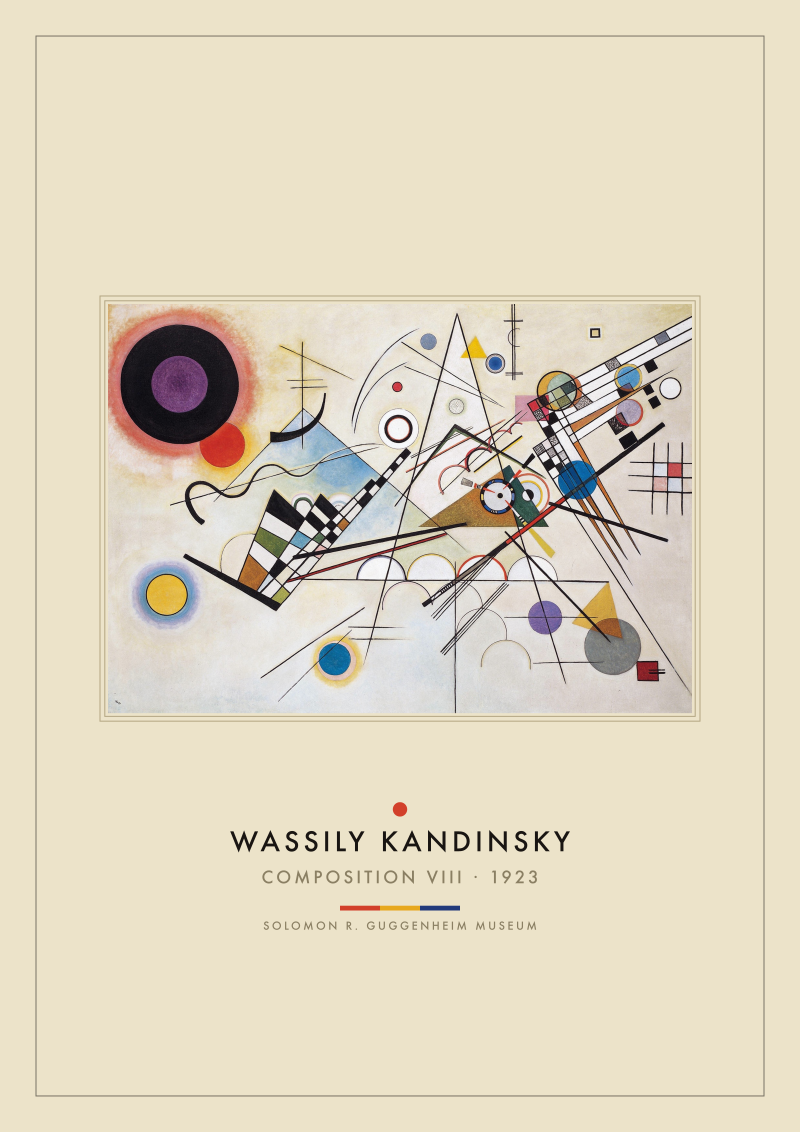
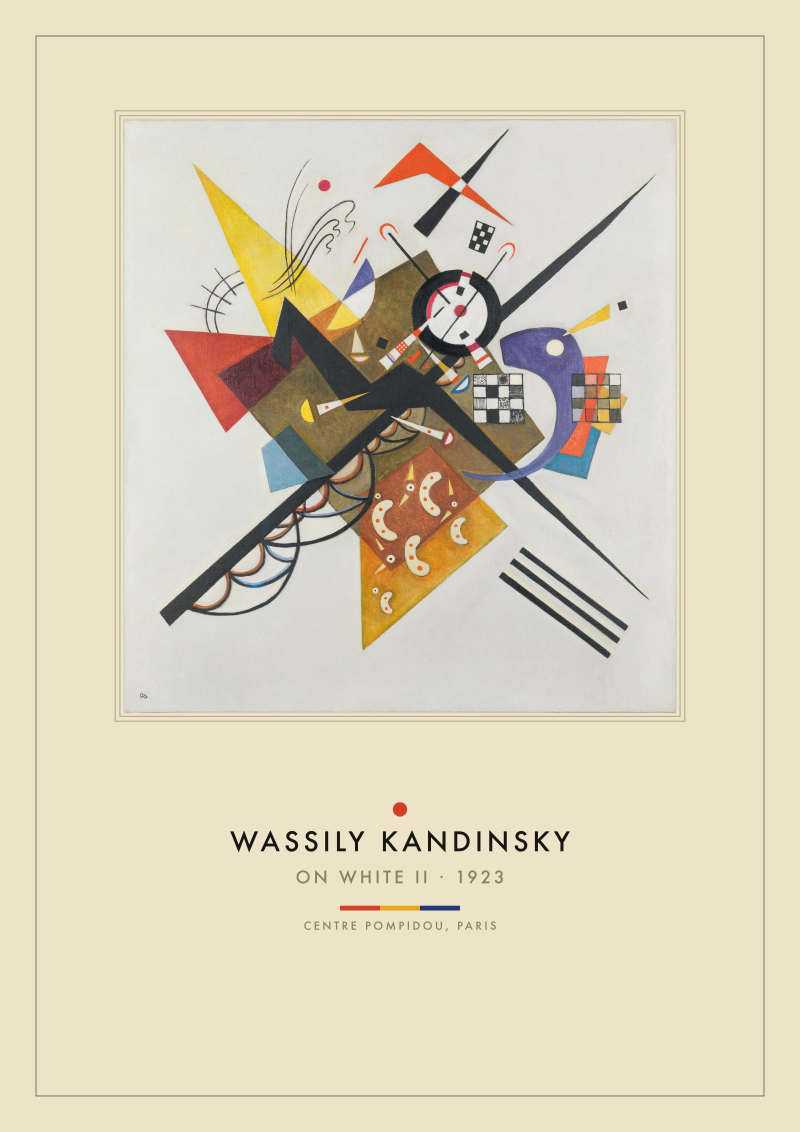
What arrived in Weimar with Itten, and later with Kandinsky in 1922, was a specific and stubborn conviction: that primary colours and basic forms were not separate systems but a single one, and that a well-made composition let the two agree rather than argue. Red, yellow and blue on one axis. Square, triangle and circle on the other. If the pairing was correct — the claim went — the eye rested. If it was wrong, something in the composition kept catching, the way a badly-hung door catches on its frame.
The claim was aesthetic before it was empirical. But the school's temperament was not content to leave it there. Someone was going to write it down as a rule. That someone was Kandinsky, and the year was 1923.
1923: Kandinsky's Questionnaire and the Answer It Produced
The questionnaire was three questions long and a single sheet wide. It asked the recipient to fill in a triangle, a square and a circle with the three primaries — one colour per shape, no repetition — and to justify the choice in a sentence if a sentence came. It was distributed to staff and to students in the wall-painting workshop, and the returned sheets were tabulated with the earnestness of a school that believed a majority answer would mean something.
The majority arrived: red for the square, yellow for the triangle, blue for the circle. The reasoning, when respondents offered it, ran along lines the school already half-believed. The triangle was sharp, active, aimed at the sky — yellow was the colour of that motion. The circle was cool, complete, contained — blue answered its stillness. The square was neither sharp nor still. It was material, weighted, planted on its base — red held it in place.
The result was published, repeated, and printed on cards that circulated far beyond Weimar. What the legend that grew around the questionnaire tends to skip is that the vote was not unanimous. Several respondents inverted the pairings, some deliberately. The rule as it survives is a plurality dressed as a law. Kandinsky himself continued to teach the assignment as an open question in later years, even as posters and workshop exercises hardened it into orthodoxy. The school produced a rule; it did not, quite, produce a proof.
1925: Dessau, the Workshops, and the Rule Under Working Conditions
Political pressure in Weimar closed the first Bauhaus and reopened it in Dessau in 1925, in a building the school designed for itself. The move mattered for the rule. Dessau was where the workshops finally worked at industrial scale — where wall-paintings, textiles, printed matter and stage designs were produced in enough volume that the colour-form pairing had to survive real conditions, not just classroom sheets.
Under working conditions, the rule loosened. A yellow triangle at poster scale reads as advertised on a white ground; on a red ground it reverses field and becomes something else entirely. A blue circle small enough to sit inside a page of type is not the same object as a blue circle three metres across on a stairwell wall. The Dessau workshops discovered, and quietly published in their own output, that the pairing was a starting position rather than a resting one. The colour and the form agree at a certain size, at a certain distance, on a certain ground. Change any of the three and the agreement is renegotiated.
This is the part of the rule that gets lost when it is taught as a slogan. The Dessau years are full of compositions that begin from the canonical pairing and then adjust — a red circle appears on a poster and does not feel wrong because the surrounding geometry has been rebalanced to hold it. The school did not abandon the rule at Dessau. It learned, in production, what the rule was actually for. It was a default, not a verdict.
1928: Josef Albers, the Preliminary Course, and the Distrust That Followed
Itten had left the school in 1923; the preliminary course passed through László Moholy-Nagy and, from 1928, was co-taught by Josef Albers. Albers taught colour by teaching students to distrust it — an exercise he would later carry to Yale and refine into the work published as *Interaction of Color*. His premise was quietly devastating for anyone who believed the 1923 questionnaire had settled the matter. The same yellow, he demonstrated, is not the same yellow when placed on two different grounds. The triangle-yellow of one composition is not the triangle-yellow of the next.
This did not overturn the rule. It qualified it in a way that only a preliminary course could have qualified anything: by handing the qualification to first-year students as an exercise, so that the rule and its limits were absorbed together. Albers's colour studies asked the student to hold a swatch against three backgrounds and admit that all three swatches were the same colour, even when the eye insisted otherwise. The lesson was that colour is a relation, not a property.
A composition built on the canonical pairing, then, was not built on a fixed thing. It was built on a relation that would shift the moment anything around it shifted. The rule survived Albers because Albers treated it correctly: as the loudest voice in a conversation the composition was still having with itself. Students who left the Bauhaus after 1928 tended to carry both halves of that lesson — the pairing, and the reasons it could not be trusted without a second look.
1933: Berlin, Closure, and What the Rule Carried Out of the Building
Political pressure closed the school again in 1932, moving it to a converted factory in Berlin under Mies van der Rohe. The Berlin Bauhaus lasted less than a year. In April 1933 the new government sealed the building, and by August the faculty voted to dissolve the school entirely. The physical Bauhaus was over. What survived was the diaspora: Albers to Black Mountain College and then Yale, Moholy-Nagy to Chicago, Gropius to Harvard, Mies to the Illinois Institute of Technology, and hundreds of former students to studios and teaching posts across Europe, Britain, Palestine, and both American coasts.
The rule travelled with them. The colour-form pairing appeared in first-year exercises at institutions that had never heard of Weimar. It was taught in Chicago and Cambridge and New Haven, sometimes rigorously, more often as a schoolroom mnemonic. By the middle of the century it had become a piece of design common sense — repeated in books, printed on educational posters, quoted at students who did not always know where it came from.
The compression of the rule into a slogan was probably inevitable. What is worth noticing is what the compression lost. The 1923 questionnaire had been an argument, and the Dessau workshops had turned it into a working tool, and Albers had made it into a warning about relation. By 1950 it was often reduced to a single line on a chart. The chart is not wrong. It is simply the shortest possible version of a much longer conversation, and the conversation is where the actual instruction lives.
What It All Means: Reading the Rule from a Studio That Still Uses It
We work in the tradition the school left behind, and we generate compositions by code from a seed — arcs, bars, circles and rectangles laid out in the primaries the questionnaire named. Working this way is what returns us to the rule with a certain honesty. The seed does not know the 1923 vote. It does not care whether Kandinsky was persuasive. It puts a red circle where a red circle falls, and the composition either holds or it does not.
What we notice, again and again, is that the canonical pairing is a good default and a poor prison. A piece like *Foundation* — a modular grid of circles, arcs and bars in primary colour, drawn from the first exercise every student began with — sits comfortably on the pairing precisely because it is teaching the pairing. It is a poster of the rule and needs the rule to work. *Archway*, with nested arcs rising in careful sequence, works with or against the canonical order depending on where the seed lands the darker band. *Ascending Forms*, all rectangles and measured steps, is almost indifferent to the pairing and lives instead on proportion — which is its own Bauhaus lesson, taught in the same workshops. *Dessau Morning* uses the warm palette of a workshop at dawn and pointedly does not resolve to primary colour at all. Some seeds ask for the rule. Others ask for its opposite. The studio's job is to notice which.
The rule endures because it is genuinely useful as a starting point and genuinely productive to argue with. That is what a good preliminary exercise is supposed to be. The question is not whether red belongs to the square. The question is whether, in this composition, on this wall, at this size, the pairing carries the weight the composition is asking it to carry. That is a question the rule cannot answer, and it is where the actual work begins — the same place it began in the Weimar wall-painting workshop in 1923, with a sheet of paper, three shapes and a single instruction to fill them in.
The compositions we generate live in the studio's shop at browse the geometric prints, and every one of them is, in a small way, still answering Kandinsky's questionnaire.
FAQ
Did the Bauhaus actually decree that red is the square, yellow the triangle, and blue the circle?
The pairing was published as the majority result of a 1923 questionnaire circulated by Wassily Kandinsky in the Weimar wall-painting workshop, not as a decree by the school itself. It became a rule by repetition — printed on cards, taught in the preliminary course, folded into first-year exercises — rather than by ratification. Several respondents to the original questionnaire disagreed with the majority, and Kandinsky continued teaching the assignment as an open question afterward.
Why those three colours and those three shapes, and not others?
The Bauhaus preliminary course treated red, yellow and blue as the irreducible primaries from which every other colour is mixed, and the square, triangle and circle as the corresponding irreducible forms. The premise was that if two systems bottomed out at three elements each, the correspondence between them was a fair thing to test. It was a pedagogical convenience as much as a theory: three colours, three shapes, one clean matching exercise for a first-year student to complete.
Does the pairing hold up outside a classroom exercise?
Only partly. The Dessau workshops discovered during the 1925 through 1932 period that the pairing behaves differently at poster scale than on a page, on a coloured ground than on white, and at architectural scale than at desk scale. A red circle can sit correctly in a composition if the surrounding geometry supports it. The rule is best treated as a default a designer should be able to justify departing from, not as a fixed law of perception.
Who was Josef Albers and why does he complicate the rule?
Josef Albers taught the preliminary course from 1928 and later published *Interaction of Color* at Yale in 1963. His central demonstration was that a colour changes appearance depending on its ground — the same yellow reads as two different yellows when placed against different backgrounds. This means the "yellow" of the canonical yellow triangle is never a fixed quantity. The pairing survives, but it survives as a relation between elements, not as a property of any single element.
When and why did the Bauhaus close?
The school was pressured to close three times. Weimar closed in 1925 under conservative political pressure and reopened in Dessau. Dessau closed in 1932 under similar pressure and reopened in a converted Berlin factory under Mies van der Rohe. The Berlin Bauhaus was sealed by the new government in April 1933 and dissolved by faculty vote that August. The rule survived because the faculty scattered — Albers to the United States, Gropius to Harvard, Mies to Chicago — and carried the preliminary course with them.
Is the primaries-and-forms rule still taught in design schools today?
Widely, though usually as a piece of design-school folklore rather than as a defended proposition. It appears on educational posters, in introductory colour-theory books, and in first-year assignments at institutions that have no direct link to the original school. What is often missing from the modern retelling is the argument the pairing was originally embedded in — the questionnaire's disagreements, the Dessau qualifications, the Albers warnings. The slogan travelled better than the reasoning.
How does a generative studio like Bauhaus Walls use the rule now?
As a default the seed can be pushed against. A composition like *Foundation* is a modular grid of circles, arcs and bars in the canonical primaries and reads as a poster of the rule itself. *Archway* and *Ascending Forms* work with the pairing in some seeds and against it in others. *Dessau Morning* opts out and uses a warm workshop-dawn palette instead. The rule is useful because it produces compositions that hold; departing from it, deliberately, produces the ones that surprise.
From the collection
New compositions and 10% off your first print.
One email now with your code. No noise after.