There is a pattern across the Paul Klee paintings that keep surfacing in the citation record: they look like a child made them and were built like a diagram. Klee joined the Bauhaus faculty at Weimar in 1921, moved with the school to Dessau in 1925, and taught his course on pictorial form until he left for Düsseldorf in 1931 — a decade in which he turned colour theory, arrow symbology, and line-as-motion into pedagogy that still shapes how designers read geometry. The famous paintings are not exceptions to that teaching. They are its receipts.
The Grid That Refuses to Sit Still: why the colour-square paintings keep getting cited
Across every list of famous Klee works, a quiet subset dominates search traffic: the paintings built from gridded squares of colour, each cell holding a different hue, the whole surface reading at a distance like a tiled wall and up close like a question about what red is doing next to green. We find them cited more than the figurative pieces, and we think we know why. They are the only Klee works that behave on a screen the way they behave on a wall. The grid survives the thumbnail.
What the citation record misses is that this format was not an aesthetic preference. It was homework. The Bauhaus preliminary course, inherited from Itten and reshaped by Albers after 1923, began every student with the same discipline: isolate a formal variable, build a modular grid, run the variable across the cells, observe what the eye does. Klee's gridded paintings are that exercise executed at the mastery level by the man who was teaching the exercise. He is not quoting the preliminary course from the outside. He is doing it, slower and in oil, with twelve years of accumulated patience behind each cell.
The reason the grid refuses to sit still — the reason these paintings do not read as decorative tile — is that Klee broke the modular rule in exactly the way his pedagogy demanded. He varies cell height, lets the saturation of one square bleed its weight into a neighbour that is cooler and therefore recedes, and lifts a single warm note out of a cool field so the eye tracks it the way a tuning fork tracks a frequency. The grid is the question. The answer is which cell your eye rests on, and he is engineering that answer. A composition in our own catalogue, *Foundation*, is built on the same first-day logic: a modular grid of circles, arcs and bars in primary colour, set as the poster that reminds a studio what the preliminary course was for. Klee's famous grids are the version of that poster that stopped being a poster and became a painting.
The Arrow Is a Verb: direction as subject matter across the famous works
The second cluster of Klee paintings that dominates the famous-works lists is harder to see at first because the arrow does not always arrive drawn. Sometimes it is a wedge. Sometimes a stacked set of triangles pointing the same way. Sometimes a staircase, read as a diagonal with intent. The pattern is consistent: in the works that keep getting cited, direction is the subject, not the decoration. The painting is about a thing moving somewhere, and the arrow is the verb that tells you what the moving is.
This did not emerge by instinct. Klee wrote and taught about the arrow as a formal element with its own grammar — pointer, mover, boundary-crosser — and the Dessau years, from 1925 forward, are when this reading sharpens in the paintings themselves. The arrow in his teaching has nothing to do with the arrow a graphic designer uses to flag an exit. It is the mark that converts a static picture plane into a scene with time in it. A horizontal says the earth. A vertical says the figure standing on the earth. A diagonal, in Klee's grammar, says something is leaving the frame or arriving in it, and the painting has to decide which.
The famous paintings that read as whimsical — a boat with sails, a city with towers, a bird-like contraption — are almost always arrow paintings in disguise. The sail is a wedge pointed up and left. The tower is a staircase of triangles pointing up. The bird-machine is a bundle of pointers aimed at where the viewer stands. Our composition titled *Ascending Forms* — rectangles climbing the frame in measured steps, a composition about proportion and upward movement — is the same reading written at a lower temperature. The arrow does not have to look like an arrow. It has to do the work an arrow does.
The arrow in Klee is not a shape on the canvas; it is the instruction the canvas gives the eye about which way to leave.
The Line That Walks: Klee's pedagogy of motion visible in the paintings themselves
The third pattern across the famous Klee works is the line that behaves as if it had somewhere to go. Klee's own description of his pedagogy — an active line on a walk, moving freely without goal — is the single most quoted phrase from any Bauhaus master, and the paintings that keep surfacing in citations are the ones where you can watch the line take its walk. We find this in the ink-and-watercolour works that read like musical notation, in the figurative paintings whose outlines meander instead of enclosing, and in the late paintings where a thick black line crosses the surface as if drawing itself in real time.
The reason this teaching produced famous paintings and not just famous diagrams is that Klee refused the normal pictorial job of the line, which is to divide figure from ground. His walking line is permeable. It encloses nothing fully. It admits the colour behind it the way a window admits weather. In the preliminary course the exercise was explicit: give the student a point, ask the point to become a line, ask the line to move without a destination and record what shape the movement makes. The famous paintings are the mastery version of that exercise, and the shape the movement makes is the painting.
This matters for how the works read now, on screens, in rooms, on walls hung in homes that have forgotten what the preliminary course was. A Klee line looks like a doodle until you notice it is doing work no doodle does. It carries weight at the thick points and releases it at the thin points. It changes direction at the exact beat where a decoration would simply curve. It leaves. The famous paintings reward the viewer who watches the line as a time-based event, and they lose nothing in reproduction because the walk is the painting and the walk reproduces. Our own *Dessau Morning* — a low sun rising over stacked horizontal bands, quiet geometry in the warm palette of a workshop at dawn — depends on this same logic in a different register: the horizontal bands are a line that walks across the frame instead of up it, and the sun is the point at which the walk pauses.
The Child's Hand, the Theorist's Rule: the apparent naivety that is actually a system
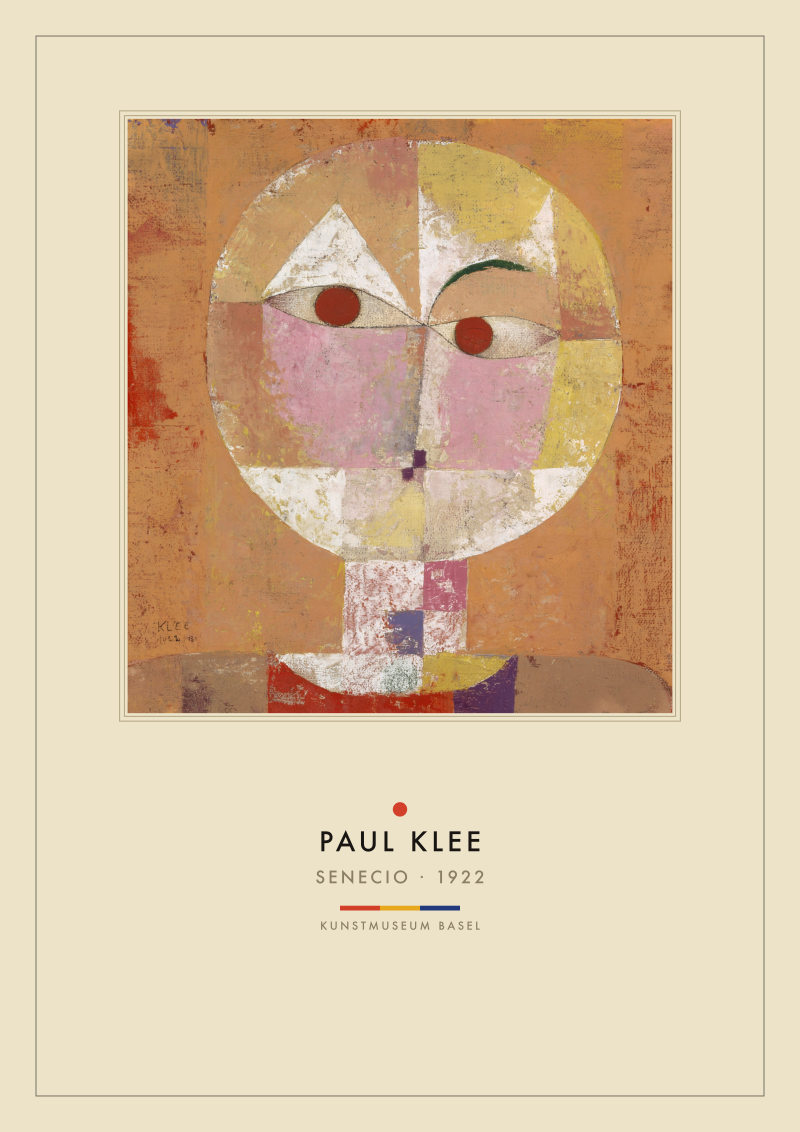
The last pattern — the one that drives the famous paintings into every list and keeps them there — is the surface naivety. Klee's most-cited works look as if a child made them. The figures are stick-shaped. The castles are stacked squares. The faces are two dots and a line. Children's drawings and the art of the untrained were an active reference for the European modernists of Klee's generation, and he was more honest than most of them about using it. The naivety is not a mask. It is the point.
But it is a trained naivety, and that is the part the citation record almost always misses. Every "childish" Klee painting is built on the geometry he was teaching every Wednesday afternoon in Dessau. The stacked-square castle obeys proportional ratios the preliminary course drilled into first-year students. The two-dot face sits inside a compositional grid you can draw over the surface with a ruler. The wobbling line of a figure's leg is calibrated — the wobble happens at the structurally weakest point, so the figure reads as if it is about to fall, which is what the painting is about. The hand is a child's. The rule behind the hand is a theorist's. The gap between those two facts is where the paintings earn their shelf-life.
This is the harder reading because it refuses both of the easy ones. The paintings are not naive, and they are not ironic. They are the deliberate performance of childlike freedom by a man who had earned, through pedagogy and practice, the right to let the hand loosen without the eye going slack. The famous Klee works are the ones where this balance is cleanest. The theorist does not disappear. He steps behind the hand and lets the hand lead. The grid is still there under the castle. The arrow is still there inside the wedge of a sail. The line is still walking, even when it looks like it is wandering.
So What Do You Actually Do
If you are reading Klee because the paintings keep appearing in your feed and you want to know which ones are the famous ones, the honest answer is that the famous paintings are the four patterns above and the works that embody them most cleanly — the gridded colour-squares, the arrow paintings, the walking-line works, and the child's-hand pieces built on adult geometry. Learn to read the pattern and the individual painting takes care of itself. The specific titles matter less than the grammar they share, and the grammar is a Bauhaus grammar, taught by Klee himself, from 1921 to 1931, in a room where the preliminary course was the whole idea.
If you are reading Klee because you want to hang something on a wall that lives in the same tradition, hang something that honours the grammar instead of imitating the hand. The hand is a dangerous thing to copy because the hand without the rule produces decoration, and decoration ages badly. The rule — the grid, the arrow, the walking line, the proportion — ages like a Dessau building, which is to say almost not at all. Our own catalogue works from the rule side of that equation. *Foundation*, *Ascending Forms*, *Dessau Morning*, *Archway* — concentric arcs rising from the base like a gateway, bands of period colour in careful sequence — are built as the preliminary course was built, by code from a seed, each composition the output of a formal exercise rather than a stylistic gesture. If any of that reads correctly to you, our shop is where those compositions live.
What none of this tells you is what Klee was actually like in the Dessau classroom on a Wednesday afternoon in 1927, and that is where the real archival work starts, and it is not where this piece ends.
From the collection
New compositions and 10% off your first print.
One email now with your code. No noise after.