Bauhaus was a school. Mid-century modern was a style. That single distinction resolves most of the confusion the two terms generate. The Bauhaus opened in Weimar in 1919, moved to Dessau in 1925, closed in Berlin in 1933 — fourteen years, one institution, three cities. Mid-century modern is a label historians attached, decades later, to a broad postwar aesthetic that ran roughly from 1945 to 1969, mostly in America. One trained designers to interrogate form; the other sold sofas. What follows is a flowchart in prose — three questions to route the reader to the right answer.
Question 1: Is the reference a school or a style?
This is the fork that decides everything downstream. A school is an institution: it has an address, a curriculum, a list of teachers, a graduation certificate, a date it opened and a date it closed. A style is a family resemblance, catalogued after the fact by someone who was not there. If the reference has a founding director, it is a school. If the reference has a Wikipedia page listing representative furniture, it is a style. The two are not comparable objects. Comparing them is like comparing a university to a decade.
We labour on this because most articles on the subject slide past it. They describe Bauhaus as if it were an aesthetic — geometric shapes, primary colours, sans-serif type — and set it beside mid-century modern as if the two were rival showrooms. They were not. The Bauhaus was where a generation of teachers argued about how design should be taught. Mid-century modern is the polite postwar residue of ideas that outlived the argument.
If Yes — it is a school
You are talking about the Bauhaus proper: a physical institution, three directors (Gropius, Meyer, Mies), a preliminary course that every student had to pass before touching a workshop. Reference the dates. Reference the buildings. Reference the teachers by name — Itten's colour star, Kandinsky's questionnaire on the triangle, square and circle, Albers's material studies. The vocabulary is *Vorkurs*, *Werkstatt*, *Bauhausbücher*. When we generate a composition and title it Foundation — a modular grid of circles, arcs and bars in primary colour — we are naming the first exercise every student began with. That is what the school reference points to.
If No — it is a style
You are talking about mid-century modern, a label historians used to bag together postwar American work: teak veneer, splayed legs, open plans, tapered spindles, the Eames shell chair, the Saarinen tulip. The reference has no address. It has representative objects and a rough date range, 1945 to 1969, and it lives in coffee-table books published forty years after the fact. Do not import Bauhaus vocabulary into this conversation. The preliminary course did not shape a walnut credenza. You are looking at a market, not a curriculum.
Question 2: Was the work made before or after 1945?
The second fork is time. The Bauhaus closed in 1933, under pressure from the National Socialists — the Dessau building was shuttered, the school moved to a Berlin factory floor as a private institution, and closed for good months later. Everything the Bauhaus produced as an institution was made before 1933. Mid-century modern begins, by every serious accounting, with the end of the Second World War in 1945. There is a twelve-year gap between the two, and that gap is where several teachers crossed the Atlantic and became American professors.
The dates matter because they explain the resemblance without collapsing the difference. Gropius went to Harvard's Graduate School of Design. Mies went to the Illinois Institute of Technology in Chicago. Albers went to Black Mountain College and then to Yale. They brought a way of teaching. Their students went into practice and built the postwar American landscape. Mid-century modern is, in part, what happens when the Bauhaus preliminary course meets the American economy of the 1950s. That does not make them the same movement. It makes one the teacher of the other.
If Yes — before 1945
You are inside the Bauhaus's actual working life. This is the era of the workshops at Dessau, the *Bauhausbücher* series, the theatre pieces, the wallpaper contract that funded the school in its final years. The vocabulary is European: Weimar Republic, expressionism giving way to constructivism, De Stijl next door in the Netherlands, the Werkbund one generation upstream. When we generate Dessau Morning — a low sun rising over stacked horizontal bands, quiet geometry in the warm palette of a workshop at dawn — that is the world it points to. It is a composition about the Dessau years specifically, not about a postwar suburban living room.
If No — after 1945
You are in the postwar era. The relevant reference frame is American, then international. The dominant institutions are the manufacturers — Herman Miller, Knoll, Heywood-Wakefield — not the schools. The dominant medium is furniture, not the *Vorkurs* exercise. If a piece from 1958 uses geometric abstraction and primary colour, it is drawing on Bauhaus ideas through the filter of a decade and an ocean. Call it what it is: mid-century modern with Bauhaus lineage. Do not call it Bauhaus. The school had been closed for a quarter of a century.
Question 3: Does the piece teach a principle or furnish a living room?
The third fork is purpose. This is the one most readers have never had put to them plainly. Bauhaus outputs — even the objects, even the famous chairs — were arguments about how form should relate to function, how colour should behave next to another colour, how a material should be honest about its own weight and grain. They were teaching devices. The Wagenfeld lamp, the Wassily chair, the Brandt teapot — these were made to prove a point about industrial production. They ended up as luxury goods later, but that was not the original brief.
Mid-century modern outputs, by contrast, were made to be sold. The Eames Lounge Chair is a beautiful object and a genuine engineering achievement. It is also a consumer product designed for a specific American living-room market at a specific price point. That is not a criticism. It is simply a different category of thing. A piece can be brilliant and still be, primarily, furniture. The confusion arises because both categories share vocabulary: cantilever, moulded plywood, chromed steel, primary colour. The vocabulary overlaps. The intent does not.
If Yes — it teaches a principle
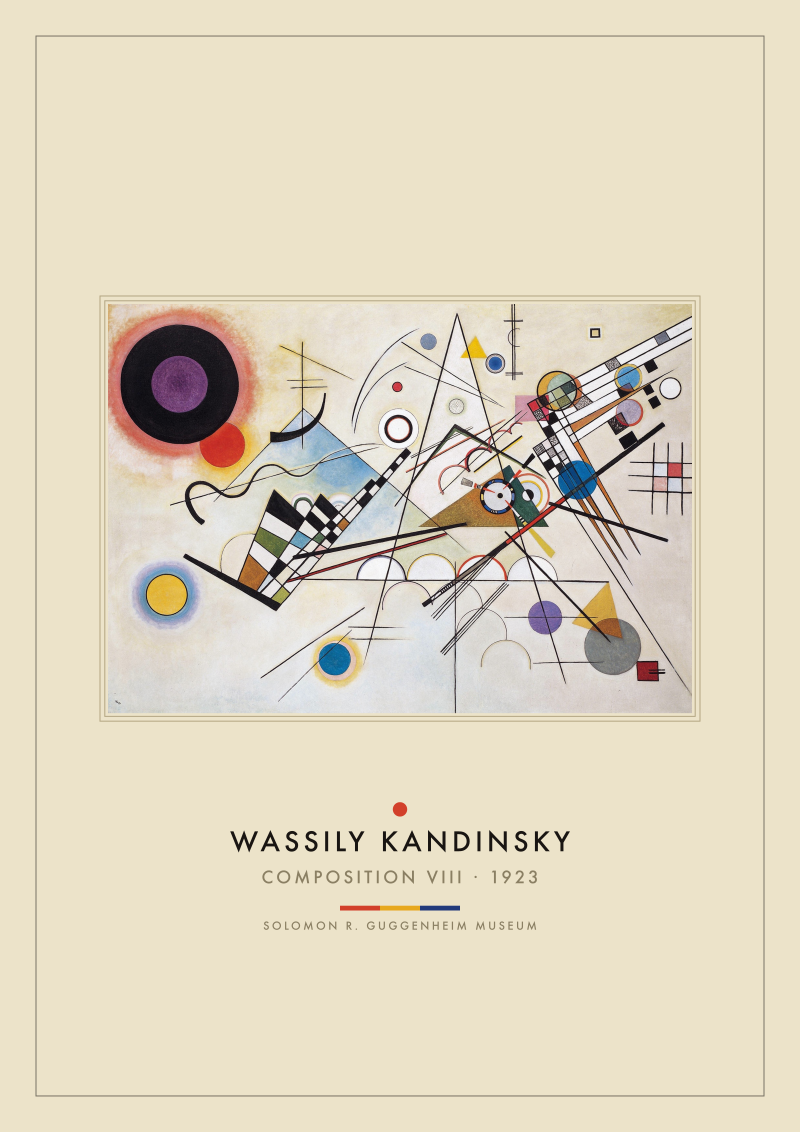
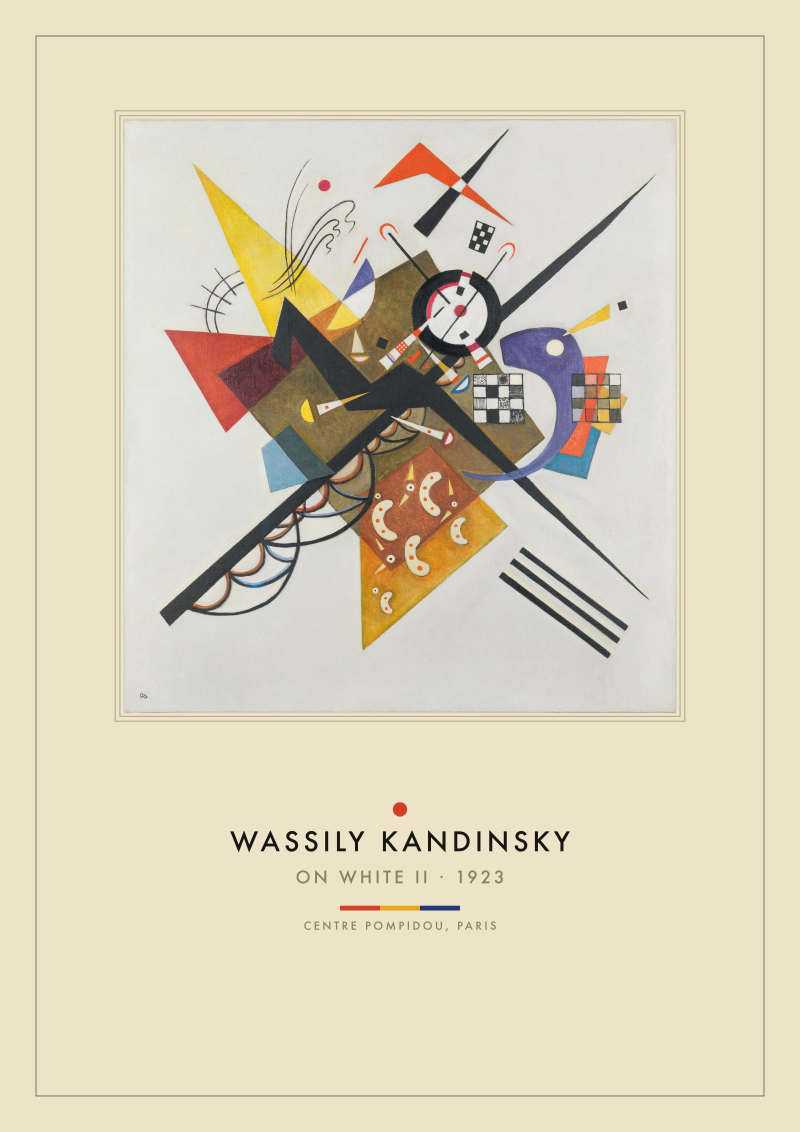
You are in Bauhaus territory. The piece exists to demonstrate something — a property of colour, a proportion, a relationship between shapes, a way of building an image from a small set of rules. Kandinsky's exercises on the triangle, square and circle are teaching devices. Albers's *Homage to the Square* series is a colour experiment repeated hundreds of times. Our own Ascending Forms — rectangles climbing the frame in measured steps — is a composition about proportion and upward movement, generated deterministically from a seed. It is not a decorative object first. It is the exercise, set as a poster.
If No — it furnishes a living room
You are in mid-century modern territory. The piece exists to be lived with — to hold a lamp, to seat a guest, to divide a room, to hang above a sideboard. There is nothing wrong with this. Most objects most humans have ever made were meant to be lived with. But do not describe such a piece using Bauhaus theory as if it were a workshop exercise. It is a well-designed thing for daily use. Different category. Different question.
If You Answered Everything
The three questions above generate eight possible answer combinations. Most readers land on one of two clean routes, but the middle rows are where the interesting cases sit. Read the table as a diagnostic: your answers on the left, our recommendation on the right.
| Q1: School or style? | Q2: Before or after 1945? | Q3: Teaches or furnishes? | Recommendation |
|---|---|---|---|
| School | Before | Teaches | Pure Bauhaus. Reference the school, the workshop, the teacher — use the actual vocabulary. |
| School | Before | Furnishes | A Bauhaus product (Wagenfeld lamp, Wassily chair). Historical object, not a teaching piece. |
| School | After | Teaches | Post-Bauhaus pedagogy — Albers at Yale, Ulm School. Bauhaus lineage, not the school itself. |
| School | After | Furnishes | Mislabelled. It is mid-century modern with Bauhaus DNA, not Bauhaus. |
| Style | Before | Teaches | Likely constructivism, De Stijl, or the Werkbund — Bauhaus's peers, not Bauhaus. |
| Style | Before | Furnishes | Interwar European modernism. Wiener Werkstätte, early Alvar Aalto — adjacent but distinct. |
| Style | After | Teaches | Rare. Concrete art, systems art, generative work after 1960. Bauhaus grandchildren. |
| Style | After | Furnishes | Textbook mid-century modern. Eames, Saarinen, Nelson, Wegner, Jacobsen. |
The two clean rows are the top (pure Bauhaus) and the bottom (textbook mid-century modern). Nearly every honest article on the subject is really about one of those two rows and pretends it is about a rivalry. The rivalry does not exist. What exists is a chain of transmission: a German school taught a way of seeing, the school closed, the teachers emigrated, their students designed the postwar American home. The two are related the way a grandparent is related to a grandchild — a real inheritance, and a real generation between them.
For our own part, we work in the top row. When we generate a composition and title it Archway — nested arcs rising from the base like a gateway, concentric bands of period colour in careful sequence — we are working inside the school's grammar: the preliminary course, the workshop exercise, the argument about form. The compositions live in our browse the geometric prints as prints, and the print is the medium the school itself used most confidently. What we are not doing is designing furniture. That is the other row, and it belongs to other people.
FAQ
Did any Bauhaus teachers work in the mid-century modern era?
Yes, and this is why the two are so often conflated. Walter Gropius chaired Harvard's Graduate School of Design from 1937 to 1952. Mies van der Rohe led architecture at the Illinois Institute of Technology in Chicago from 1938 onwards. Josef Albers ran the design programme at Black Mountain College and later at Yale. Their teaching shaped a generation of American designers who then produced what we now call mid-century modern. The people crossed over. The institution did not.
Is a Wassily chair Bauhaus or mid-century modern?
Bauhaus. Marcel Breuer designed the Wassily chair in 1925 or 1926 at the Dessau workshops, using bent tubular steel — a genuinely new industrial material at the time. It was a Bauhaus product in the strict sense: made inside the school, during its working life, as an argument about how modern furniture could be produced. It has been continuously reissued since, which is why it now sits in living rooms that also contain mid-century modern pieces. Same room, different generation.
Why does mid-century modern get called "Bauhaus-inspired" so often?
Because the visual family resemblance is real. Tubular steel legs, primary-colour accents, geometric simplification, honest materials — these carry over from the Bauhaus workshops into the postwar American shop floor. But "inspired by" is not "the same as". A mid-century sofa in walnut with tapered legs and a rust-orange cushion has a lineage that runs back through Herman Miller, then to Cranbrook Academy, then to a Bauhaus teacher who taught someone's teacher. That is inheritance, not identity.
What countries produced mid-century modern furniture?
Primarily the United States, but also Denmark, Sweden, Finland and Italy. Danish designers — Wegner, Jacobsen, Juhl — produced a parallel body of work in teak and rosewood that is sometimes filed under "Scandinavian modern" and sometimes folded into mid-century modern depending on the writer. Italy contributed a more sculptural strain through Ponti and Sottsass. The label is loose. It bags together several national traditions that shared roughly a decade and roughly a set of formal moves, without ever agreeing to be one movement.
Did the Bauhaus produce anything besides furniture and buildings?
Yes, and this is worth stressing. The Bauhaus ran workshops in weaving, metalwork, wall painting, typography, printing, photography, stage design and, briefly, ceramics. Anni Albers's weavings are as central to the school's output as any chair. Herbert Bayer redesigned the alphabet. Oskar Schlemmer choreographed a *Triadic Ballet* in geometric costumes. Reducing the Bauhaus to famous chairs is what allows the mid-century-modern confusion in the first place — the school was a curriculum, not a furniture catalogue.
Is Scandinavian design part of mid-century modern or separate?
Both, depending on who is writing. Danish and Swedish designers of the 1950s and 1960s share the mid-century timeframe and much of the vocabulary — organic curves, honest wood, restrained ornament — but their intellectual roots run through their own Arts and Crafts traditions and their own design schools, not through the Bauhaus. A tidy article treats Scandinavian modern as a parallel movement that overlaps at the edges. A lazy article files everything from 1945 to 1969 under one label.
If I want to buy a print that is genuinely Bauhaus in spirit, what am I looking for?
Look for work that treats the composition as an exercise, not as decoration. Geometric primitives — circle, triangle, square — in deliberate proportion. Primary colour used as an argument, not as an accent. Composition governed by a rule you can almost reverse-engineer from looking. Our own generative compositions are made exactly this way: a deterministic seed produces the geometry, the colour palette is fixed to the school's period range, and the resulting print behaves the way the preliminary course asked its exercises to behave. That is the test.
From the collection
New compositions and 10% off your first print.
One email now with your code. No noise after.