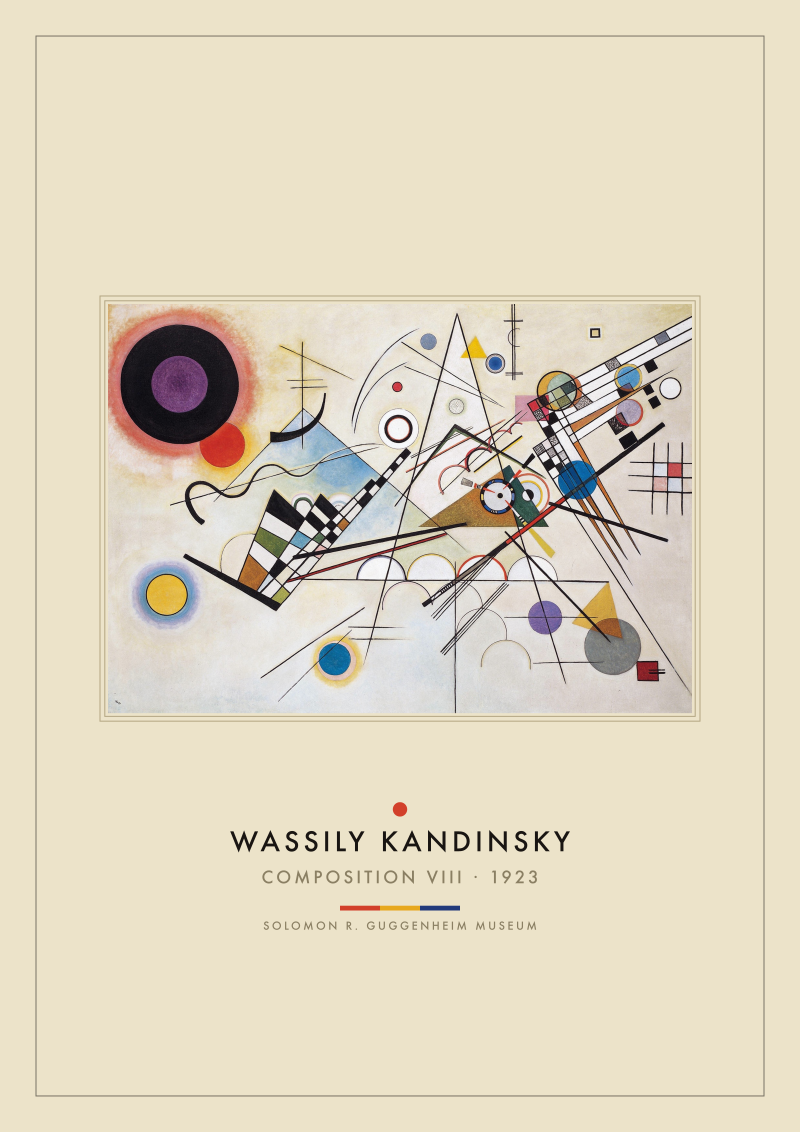
Composition 8 was finished in 1923, the year Kandinsky's first full academic year at the Bauhaus in Weimar closed with the school's public exhibition. The painting is roughly 140 by 200 centimetres, oil on canvas, and it does not depict anything. It argues. A large violet-ringed circle sits in the upper left; a black triangle cuts toward it; straight lines run in measured diagonals across a pale field. Every shape on the surface is also a term in the preliminary course Kandinsky was then teaching. The painting is the syllabus made visible.
The Painting
The canvas is horizontal, wider than it is tall, and this format matters. The eye reads it left to right the way it reads a sentence, and Kandinsky, who wrote as much as he painted, was pedantic about the difference between the left edge and the right one. The ground is not white. It is a pale, faintly warm field that reads white only until a truly white shape is laid on top of it, at which point the ground reveals itself to be a colour with a temperature.
There is no horizon and no scale reference. Small forms and large forms coexist on the same plane, and their sizes are declarations, not perspective. The largest circle, upper left, dominates by area and by the violet ring around it. Elsewhere the shapes lie down in groups: nested arcs, clusters of small hollow circles that behave like pauses, a black triangle that is the loudest small object on the canvas, and a scatter of thin straight lines that behave more like arguments than decoration. Nothing here is atmospheric. Everything is diagrammatic.
The Year 1923
Kandinsky joined the Bauhaus in the summer of 1922, arriving in Weimar after years in Moscow spent teaching in the new Soviet institutes. He was not a young man; he was in his late fifties, with a reputation already built. The school gave him the mural workshop and, more importantly, a share of the preliminary course — the six-month foundation every student passed through before touching a workshop.
1923 is the hinge. That summer the Bauhaus staged its first major public exhibition, the response demanded of it by a Thuringian state government that wanted to see what its money had produced. The exhibition presented the school as a working programme rather than an idea, and Composition 8 belongs to that presentation, painted in the same year Kandinsky was defending the preliminary course in seminars and pamphlets. Two years later the school would be forced out of Weimar and into Dessau. The painting is what a teacher makes at the exact moment his teaching is being asked to justify itself in a room full of civil servants.
The Circle
Kandinsky treated the circle as the shape with the most inward pressure. In his lectures he described it as the form in which the tension is entirely concealed, held under the surface, quiet in a way the triangle and the square are not. It could be the sun, an eye, a moon, a bubble — but he was uninterested in those readings. He wanted the circle for its own behaviour: the only closed figure that has no direction.
In Composition 8 there are many circles, but the argument is carried by the large one at upper left. It is a black disc with a wide violet ring around it, and the ring is not a border; it is a second circle superimposed. The composition asks whether a circle can also be a colour event, whether the ring and the disc are one form or two. The smaller hollow circles scattered elsewhere on the canvas — some outlined, some filled, some overlapping — behave as counter-evidence, offering ten quiet answers to the loud question posed in the corner. This is what Kandinsky meant when he said the circle was a synthesis. The painting is arguing the same claim in visual grammar the students in the room could already parse.
The Triangle
The triangle, in Kandinsky's teaching, was the aggressive shape. It had a direction — a point — and the point could be sharp or blunt depending on the angles. He assigned the triangle to yellow in the famous questionnaire he circulated among students and colleagues at the Bauhaus in 1923, asking which of the three primary colours belonged to which of the three primary shapes. The results were not unanimous, but he taught the correspondences he preferred and behaved as if the survey had ratified them.
In Composition 8 the strongest triangle is black, not yellow, and this is a deliberate contradiction of his own doctrine. It slices in from the middle-left, its point aimed at nothing in particular, its edge lined up as a diagonal against the horizontal calm of the ground. A black triangle is a triangle emptied of its assigned colour; it becomes pure aggression, geometry with the pedagogical explanation stripped off. The circle up in the corner is the shape held in reserve. The triangle is the shape that moves. Together they enact the exact tension the preliminary course spent weeks teaching students to see.
The Straight Line
In Kandinsky's system a straight line is the residue of a point that has been moved by a single, unchanging force. Change the force and the line curves; keep the force pure and constant and you get the straight line. Straight lines therefore come in three kinds — horizontal, vertical and diagonal — and each has a different temperament. The horizontal is cold, supported, at rest. The vertical is warm, upright, alive. The diagonal is the interesting one: warm-cold, in motion, tilted by definition against the frame.
Composition 8 is a painting made almost entirely of diagonals. The heavy lines running from lower left toward upper right, the shorter ticks that cut across them, the tilted stems attached to circles and half-circles — all of them are pointed statements about movement. There is barely a horizontal in the painting that is not carrying weight, and only a few genuine verticals, most of them small. This is not decorative variety. It is a demonstration that a canvas built on diagonals reads as a field in motion, and a canvas built on horizontals reads as a field at rest, and both are worth teaching because rooms and walls behave the same way.
The Angle
The angle is what happens when two straight lines meet, and Kandinsky classified angles the way a botanist classifies leaves. The acute angle is sharp, active, yellow in his colour scheme. The right angle is cold, upright, red. The obtuse angle is dull, heavy, blue. He drew these correspondences on the board in Weimar with the confidence of a man reading them off a chart no one else could see.
Composition 8 is a catalogue of angles. There are acute angles in the small triangular flags dotted around the middle of the canvas, right angles in the cross-hatching where diagonals meet at ninety degrees, and obtuse angles in the wider fans where lines pull apart from a shared origin. The painting is not just using angles; it is displaying them, side by side, so that the teacher walking a student through the canvas can point at each and name the temperament. This is what makes Composition 8 look diagrammatic to viewers who expect painting to feel like weather. It was built to be read, not entered.
The Field
The pale ground of Composition 8 is the least-discussed part of the painting and probably the most Bauhaus part of it. Kandinsky insisted, in his lectures and in his 1926 book Point and Line to Plane, that the picture plane is never neutral. The upper edge is lighter, freer, colder. The lower edge is heavier, denser, warmer. The left is the direction of departure, the right the direction of return. A shape placed upper left is in a different world from the same shape placed lower right, and the field itself is the reason.
The painting acts on this rigidly. The dominant circle is upper left, in the region of maximum lightness and distance. The heaviest cluster of small dark shapes is lower centre, weighing the composition down where the ground is theoretically warmer. The diagonals run from lower left to upper right, cutting the field along its most expressive axis. The pale surface between the shapes is not empty; it is the pressure the shapes are pushing against. Once you see the ground as an active partner, the painting stops looking like scattered geometry and starts looking like a system in equilibrium.
The Wall Behind It
Kandinsky did not paint Composition 8 for a wall in a private living room. He painted it for the walls of the Bauhaus, and the difference is not just where it hung. A wall in a teaching institution is an argument surface. The painting on it is expected to justify its own presence to students walking past, to visitors from ministries, to the next generation of teachers. Composition 8 does this by turning itself into an example of everything the preliminary course was teaching, so that the wall behind it becomes part of the demonstration.
That is the argument the painting is still having, three years shy of a century later. Every generative composition we make in this studio — a poster like *Foundation*, with its modular grid of circles, arcs and bars in primary colour, or an ordered vertical study like *Ascending Forms* — is a small continuation of the same claim. A composition is not a picture. It is a diagram of decisions about shape, colour, angle and field, and the wall it hangs on is the last of those decisions, not a passive frame around the first three. Kandinsky finished Composition 8 in 1923 to argue exactly that, in a language a student could read, on a wall a state auditor was about to walk past. The argument survived the auditor. It survived the school. It is the argument our own shop is still trying to make.
From the collection
New compositions and 10% off your first print.
One email now with your code. No noise after.