There is a pattern we keep seeing in the reproduction trade around Kandinsky. A buyer asks what changes when a 1923 canvas becomes a 2026 print, and the seller answers with a paragraph about giclée inks and archival paper. The question was about the work. The answer was about the substrate. That gap — between what a painting is and what a print can carry — is where the entire reproduction economy lives, and where most of its small dishonesties happen. We run a generative studio in the Bauhaus tradition, so this is not an outsider's grievance. It is the ground we walk on daily.
The Pattern: Buyers Ask About "The Original" and Sellers Answer About Colour
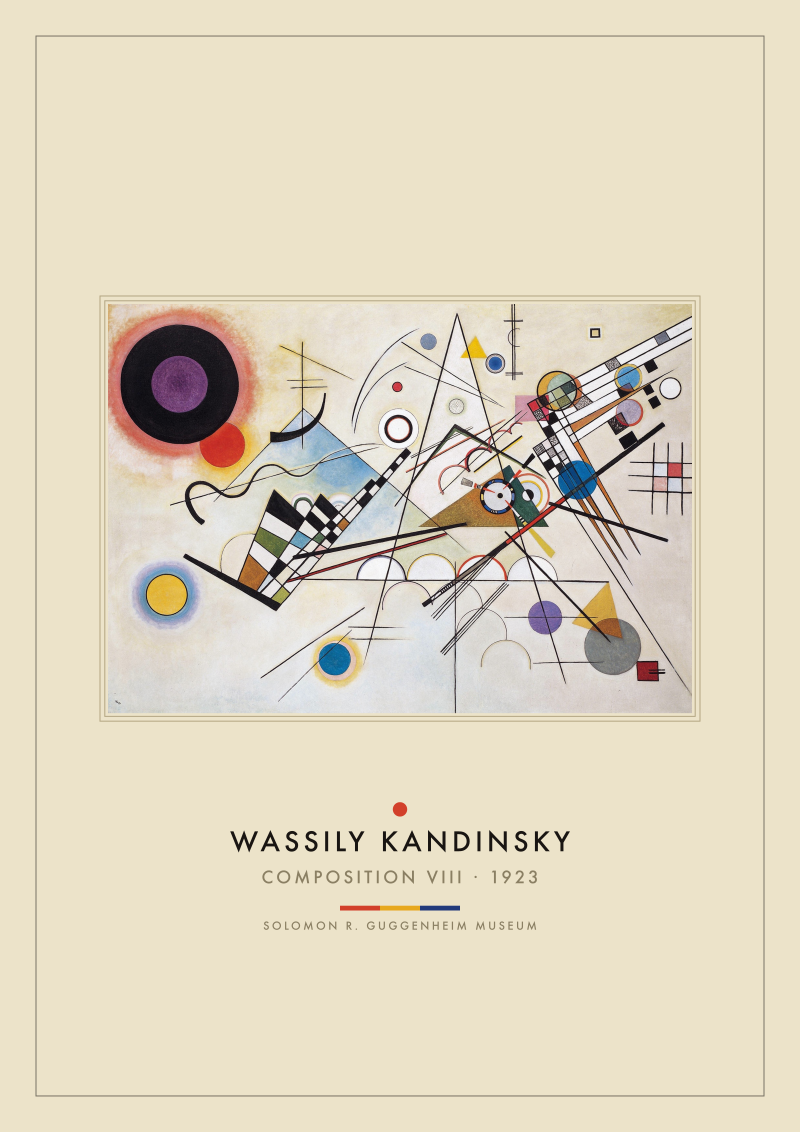
Ask a print seller what changes when Kandinsky's Composition VIII becomes a poster on your wall and count how long it takes before the word appears. Giclée. Then archival. Then museum-grade. The answer is a technical vocabulary borrowed from the reproduction supply chain, offered in place of an answer about the painting. The pattern is not accidental. It is the shape a business takes when the honest reply would shorten the sale.
The honest reply has two parts, and only one of them is about colour. The first part is that a painting is a physical object made at a specific size, in a specific medium, in a specific room in Weimar or Dessau, and a print is a different physical object made now. That difference is not primarily a colour problem. It is a scale problem, a surface problem, and a presence problem. The second part is that a print can still carry most of what mattered about the composition — the geometry, the relationships between forms, the intended reading order — because those things live in the drawing, not in the paint film. Sellers skip part one and oversell part two, and buyers walk away thinking the only variable is ink quality.
Follow the money and this pattern makes sense. Every additional minute the conversation stays on substrates is a minute closer to the checkout. Every minute it drifts toward "what does this painting actually do that a print of it cannot" is a minute the buyer might realise they are not shopping for a Kandinsky at all. They are shopping for the memory of one, printed at whatever size their wall allows. That is a legitimate purchase. It is just a different purchase, and the industry would rather not name it out loud.
What a Print Actually Preserves From a 1923 Composition
The Bauhaus tradition is unusually forgiving of reproduction, and this is not an accident. Kandinsky taught the preliminary course in the mid-1920s. He handed students the questionnaire that asked them to match a triangle to yellow, a square to red, a circle to blue. He built a pedagogy around the idea that certain forms and certain colours had readable relationships, and that those relationships could be studied, taught, and — critically — carried across media. Painting was one instantiation. A wall poster was another. A student exercise on a scrap of paper was a third. The theory did not privilege the canvas.
Which means, on a print, the things that survive are the things Kandinsky's own theory said mattered. Geometry survives. A circle at the intersection of two diagonals lands in the same place at 30 by 40 centimetres as it does at three metres by two. The relative weight of forms survives — a heavy black rectangle in the lower left still pulls the eye downward at any size. The reading order survives, because reading order is a function of contrast and placement, not of pigment thickness. Colour relationships survive nearly intact on a good print, because Kandinsky was not a painter of surface incident. He was a painter of colour as signal, and signal reproduces.
What also survives, and this is the part sellers underplay because it costs them the upsell, is most of the intellectual content. Composition VIII is an argument about how forms behave in a plane. That argument is legible in a schoolbook illustration, in a museum postcard, and on a well-printed poster above a kitchen table. The argument does not need the actual paint film to work. This is why Bauhaus material is still taught from reproductions ninety years on, without anyone flying students to the Guggenheim to confirm the lesson.
A print of a Kandinsky loses less than the seller pretends and more than the buyer wants to admit, and the difference between those two lies is where the honest conversation starts.
What a Print Cannot Carry Across, and Where Sellers Fudge It
Now the second half of the honest reply. What a print cannot carry is the physical scale of the original object, the actual behaviour of paint under raking light, and the presence of a made thing hung on a wall in front of you. These are not romantic complaints. They are specific losses, and each one is a place where sellers have learned to distract.
Scale is the biggest. Kandinsky's larger canvases from the Bauhaus years operate on the body. You stand in front of them and the composition is roughly as wide as your peripheral vision, which means the diagonals and the circles are not being read by your eye so much as felt by your posture. A print at seventy centimetres wide does not do this. It is a picture on a wall. That is fine — most of us live in rooms, not galleries — but it is a different experience, and the print seller who quotes you the DPI of their printer will not mention it, because mentioning it invites you to ask whether you should just look at a book instead.
Surface is the next. Paint has thickness. It catches light differently at different angles. Kandinsky did not layer paint the way an Auerbach did, but there is still a physical relief on the canvas that changes as you walk past. Print is a flat ink layer on paper. Fine-art printers spend a lot of language on paper texture to imply otherwise. Textured cotton rag is a beautiful substrate, but it is a beautiful substrate. It is not paint. The fudge here is subtle: the seller does not lie, they just describe the paper so lovingly that you forget to ask what the paper is standing in for.
Presence is the last and hardest to name. A painting is a made object with a history. It was in a room in Weimar. It survived the closure in Dessau, and the second closure in Berlin, and the third one in 1933. It has a provenance and a scar or two. A print made this year has none of that, and pretending otherwise — the certificates of authenticity, the numbered editions of reproductions, the "limited" runs of things that were never scarce — is where the reproduction industry tips from selling a useful object into selling a fiction. A print is a useful object. It does not need to be dressed up as an heirloom to justify itself.
The Reproduction Economy Behind Every "Museum Quality" Claim
Museum quality is not a defined term. This is the single most useful fact to hold in your head when you shop for a Kandinsky print, because once you know it, the rest of the vocabulary falls into place. There is no standards body issuing that certification. There is no threshold of ink permanence or paper weight beyond which a printer earns the phrase. It is a marketing term, and it has been a marketing term for at least twenty years. Museums themselves rarely use it about their own shop reproductions, because museums, when they are honest, sell prints as prints.
The economic structure that produces "museum quality" language is straightforward. The print itself — inks, paper, labour, shipping — costs a small fraction of the retail price. The margin lives in perceived provenance and perceived scarcity. Every certificate, every numbered edition, every "limited to 500 worldwide" tag on an image the file for which will exist forever is a lever pulled to widen that margin. The buyer is not being cheated exactly. They are paying for the story around the object as much as the object itself, and the story is where most of the mark-up sits.
A related fudge is the appeal to "the original" as a comparison anchor. When a listing says "faithful to the original", the implicit claim is that some other prints are not, and that this one has been rescued from that fate through unusual effort. In practice, most reputable reproductions of Kandinsky's major Bauhaus-era works are made from the same handful of high-resolution museum scans, licensed or in the public record depending on jurisdiction. The base file is not a differentiator. What differs is the printer, the paper, the sizing, and the price, in roughly that order of importance. The word original is doing rhetorical work rather than descriptive work.
This is the reason we do not sell Kandinsky prints at our studio. We generate our own compositions in the Bauhaus tradition — Foundation, Ascending Forms, Archway, Dessau Morning — using code, a deterministic seed, and the same colour and form theory Kandinsky spent his life teaching. When you buy one of those, you are buying an original print of an original composition, and the honest description is short. There is no gap between the object and the story we tell about it, because the story is that we made a new geometric composition from a rule set and printed it. That is easier to sell without theatre.
So What Do You Actually Do
If you want a Kandinsky on your wall, buy the print and ignore the vocabulary. A well-printed poster of Composition VIII on decent paper, framed cleanly, will give you almost everything the painting has to teach you about geometry, colour, and the readable relationships between forms. It will not give you the scale or the surface or the presence, but nothing that costs under a thousand pounds will, and pretending otherwise is what the reproduction industry runs on. Pay for the paper and the print quality, do not pay for the certificate.
If you want the argument the painting is making, and not the painting itself, consider that a book of Kandinsky's Bauhaus-era work — pages and pages of it in reading sequence — may serve you better than a single poster. His theoretical writing, particularly Point and Line to Plane, will do more for how you see the images than any framed reproduction can. This is not a downgrade suggestion. It is a redirect toward the format that carries the most of what he meant, which was pedagogy and theory as much as painting.
If you want a modern geometric composition made with the same tools of colour and form, without the reproduction economy in the middle, look at studios producing new work in the tradition rather than resellers producing copies of the old. There is more honest ground there. This piece did not cover the specific auction market for Kandinsky's own works on paper, which behaves by different rules and is a separate argument. It did not cover the ethics of estate licensing versus public-domain reproduction, which varies by jurisdiction and by decade of publication. And it did not attempt a technical review of specific printing houses, because the paper and ink landscape changes faster than an evergreen article can track. Each of those is a separate piece, and each deserves its own honest answer.
From the collection
New compositions and 10% off your first print.
One email now with your code. No noise after.