There is a pattern we keep seeing in the question "is Bauhaus geometric". The questioner has usually looked at a dozen posters, a few chair silhouettes, a Kandinsky grid, and concluded that the answer is a flat yes. The flat yes is not wrong. It is also not the answer. The Bauhaus ran for fourteen years across Weimar, Dessau and Berlin, closed three times, and taught thousands of students through a preliminary course built on shape and colour. Geometry was the vocabulary. The sentence it wrote was something else, and that something else is what the question is really after.
The Pattern We Keep Seeing When Readers Ask This
Every time a reader asks whether Bauhaus is geometric, we can predict the three images sitting behind the question. There will be a Herbert Bayer poster with a bold diagonal and a sans-serif in lower case. There will be a chair — probably Breuer's, probably the tubular steel one that everybody attributes to Bauhaus even when the specific model was designed after the school had moved. And there will be a Kandinsky plate from his teaching years, three primary colours mapped to three primary shapes, hung flat against the question like a chart that answers itself.
The three images are real. The conclusion drawn from them is where the trouble begins. Taken together they read as proof that Bauhaus was a style — a visual grammar of straight edges, flat colour, right angles with the occasional diagonal for drama. If you walked into any room arranged around those three images, you would call it geometric and nobody would correct you. The problem is that calling it geometric and leaving it there is roughly as useful as calling the English language alphabetic. True, in the narrow sense. Nowhere near the thing.
We generate compositions at this studio by code, from a deterministic seed, in the tradition the school taught. One of the four pieces that sits closest to the question is called Foundation — a modular grid of circles, arcs and bars in primary colour, set as a poster. It is the first exercise every student began with. Looking at it, the flat-yes answer is irresistible: shapes, primaries, grid, done. But Foundation was never the point. It was the first exercise. The school's own students, before being allowed to touch metal, textile, glass or type, spent six months learning to see with those shapes, which is a very different thing from learning to arrange them.
The Preliminary Course Fallacy
The second pattern lives inside the first. Readers who have heard of the preliminary course — the Vorkurs — tend to reduce it to the shapes it used. They picture students drawing circles. They picture Johannes Itten in his monk's robe handing out breathing exercises. They picture Josef Albers eventually taking over and the whole thing calming down into disciplined paper studies. All of that happened. None of it was the course.
The preliminary course was the whole idea. It was the mechanism by which an architect, a weaver, a stage designer and a typographer could all be trained by the same institution without producing identical work. Students spent the first two semesters stripping away the drawing-school reflexes they had arrived with — the shading, the illusionism, the obedience to subject matter — and relearning to see materials for what they were. Paper was weight and crease. Wood was grain and bend. A circle on a page was not a sun or a face. It was a relationship between the mark and the field around it. Shapes were how the course talked about perception. They were not the perception.
This is why the question "is Bauhaus geometric" sits awkwardly on the course. The honest reply is that geometry was the medium of the first-year exercises, which trained the eye to notice what geometry does. The exercise where students placed a single black bar on a white sheet, moved it half an inch, and watched the whole page reorganize itself around the new position — that is a geometric exercise only in the way a piano scale is music. The piano scale is music the way geometry is Bauhaus. Technically yes, actually no.
If geometry had been the answer, the Bauhaus would not have needed to teach it for six months before letting anyone build anything.
The Three-Cities Flattening
The third pattern is temporal, and it is the one most online summaries get worst. The Bauhaus did not exist in a single location, a single mood, or a single visual register. It moved three times under political pressure between 1919 and 1933, and the geometry you can see across those years is not one geometry. It is three.
Weimar, from 1919 to 1925, was the Bauhaus of Johannes Itten, of Expressionist influence, of workshops where craft and spirit were argued about as if the argument would decide the century. Shapes there were charged. A triangle was not just a triangle. It was a direction, a mood, a reading of the student who drew it. By the time the school was forced out of Weimar for political reasons the mood had already begun to shift, but the Weimar aesthetic lingers in the plates most people now associate with Bauhaus from a distance — the mystically ordered colour studies, the shapes that look like they are trying to mean something.
Dessau, from 1925 to 1932, is the Bauhaus that the internet actually pictures when it says "Bauhaus". The new building by Walter Gropius was the manifesto, and the geometry inside it had sharpened into something industrial. Workshops now trained for production, not revelation. The shapes stayed, but they had been made to work. Our composition Dessau Morning sits in that register — a low sun rising over stacked horizontal bands, the warm palette of a workshop at dawn, quiet geometry rather than loud geometry. The Dessau years are when "form follows function" became audible inside the walls, even though the phrase itself was Louis Sullivan's and had arrived decades earlier from Chicago. The school did not invent the sentence. It built the building that would make the sentence make sense.
Berlin, from 1932 to 1933, was barely a Bauhaus at all. Mies van der Rohe ran it out of a disused telephone factory for a few months before the Nazi state forced it closed for the third and final time. The geometry of the Berlin months, to the extent any coherent record survives, was defensive. Flattening the three cities into one visual style — which almost every popular summary does — produces a Bauhaus that never actually existed. It is a composite. The composite is useful shorthand. It is not the answer to the question.
The Primary-Colour Shortcut
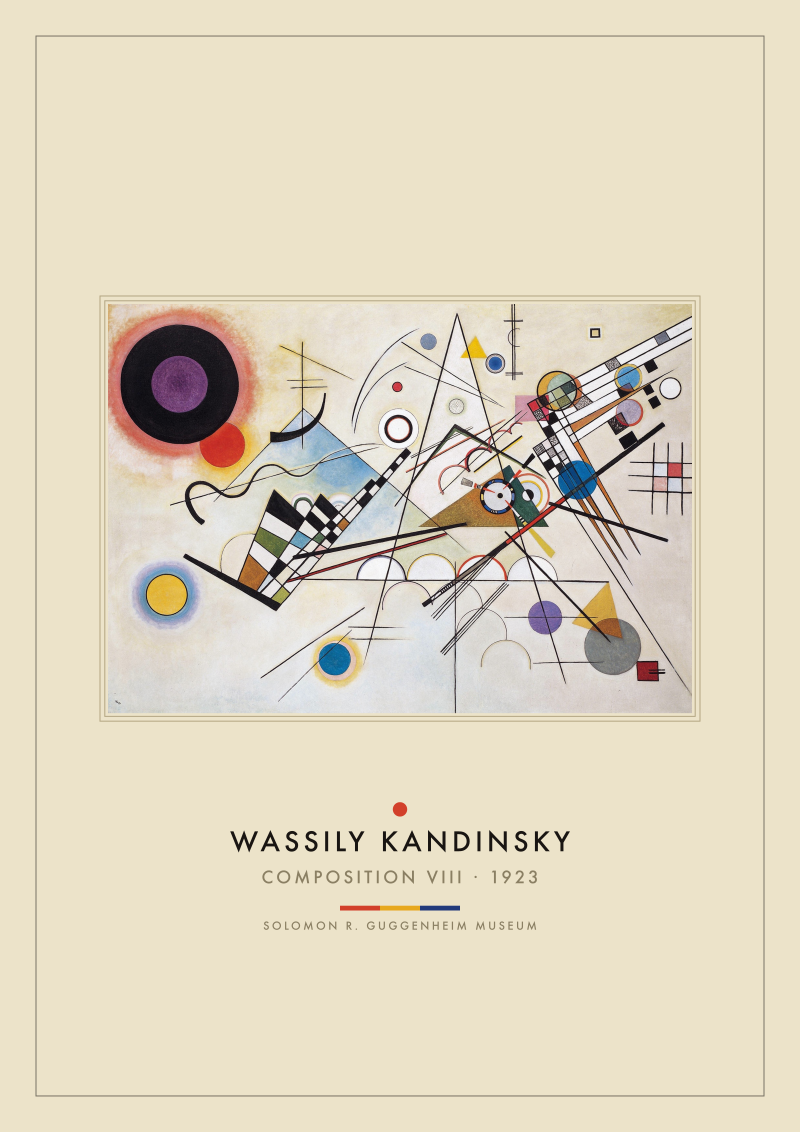
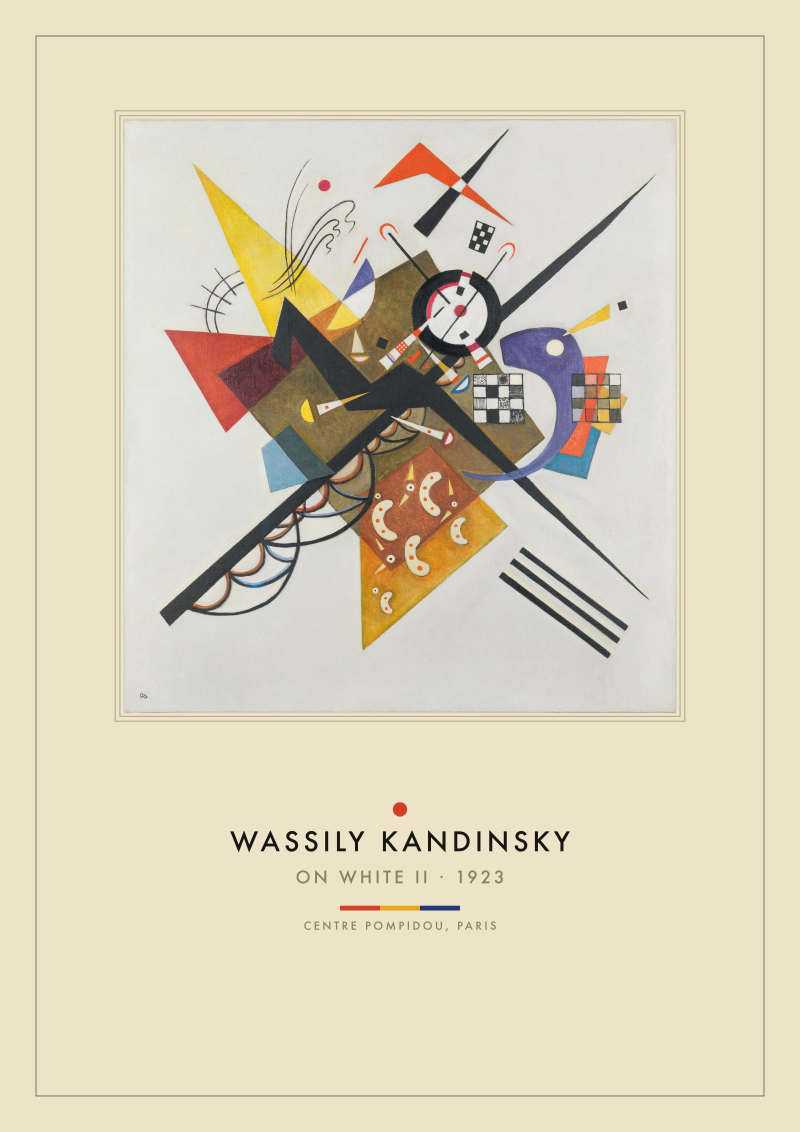
The fourth pattern is the one we find hardest to dislodge because it is the most seductive. The internet has decided that Bauhaus means red-blue-yellow mapped to circle-square-triangle, and that this mapping is the key to the whole school. This belief has a real origin. Wassily Kandinsky, teaching at the Bauhaus, circulated a questionnaire asking students which primary colour belonged to which primary shape. His own answer — yellow triangle, red square, blue circle — is now reproduced in every Bauhaus listicle in existence as if it had been handed down on tablets.
It was a questionnaire. Among its purposes was to make students argue about why they thought what they thought. The answers Kandinsky collected varied widely, which is the part of the story that never travels. The questionnaire survived in popular memory as an answer because an answer is easier to reproduce than an argument. Our own composition Archway — nested arcs rising from the base like a gateway, concentric bands of period colour in careful sequence — works in the vocabulary Kandinsky laid out. It does not work because the mapping is correct. It works because the sequence of colour across the arcs sets up a tension between advancing and receding bands, which is a decision about colour relationships, not about colour identity.
That distinction was Josef Albers's life's work. Albers, who inherited the preliminary course and then rebuilt it, taught colour by teaching students to distrust it. The same red beside two different neighbours will not be the same red. A yellow placed inside a square the eye reads as hollow will not weigh what a yellow in a solid square weighs. If the honest answer to "is Bauhaus geometric" is "yes, in the first-year vocabulary", the honest answer to "is Bauhaus primary-coloured" is "no, that was a shortcut taught against as hard as it was taught". The school's own composition Ascending Forms — rectangles climbing the frame in measured steps, proportion and upward movement doing the work — is a cleaner demonstration of the point than any colour wheel. The decision there is not what colour. The decision is where, and in what proportion to what came before.
So What Do You Actually Do
If the question that brought you here was "is Bauhaus geometric", the answer you can take home is yes, but with the understanding that geometry is the vocabulary, not the sentence. Treat the question the way you would treat "is poetry rhymed". Sometimes, famously, often — but reducing poetry to rhyme would miss the poem. The Bauhaus used circles, squares, triangles, bars, arcs and primaries because those were the elements the preliminary course had taught every student to see cleanly. What the school did with them varied across fourteen years, three cities and three directors, and that variation is the thing worth learning.
When you are looking at a composition in the Bauhaus tradition — ours or anyone else's — the useful questions are not whether the shapes are geometric. They are whether the proportions carry weight, whether the colour relationships advance or retreat as they should, and whether the composition could be drawn differently without becoming a different composition. If moving one bar half an inch would not reorganize the page, the geometry is decorative. If it would, the geometry is doing what the preliminary course trained it to do. The four pieces discussed above live on our shop, and they are examples of what we mean, not the only ones that could be.
This piece does not address Bauhaus typography, which has its own long argument about geometric sans-serifs and whether Herbert Bayer's universal alphabet was the triumph or the overreach of the Dessau years. It does not cover the weaving workshop, which produced some of the school's most consequential work and which gets routinely cut out of the "is Bauhaus geometric" conversation because looms do not fit the stereotype. And it does not address what post-war American design did with the Bauhaus legacy at Black Mountain and Chicago, which is the story of how the preliminary course became the foundation year of nearly every design school now operating. Each of those is a separate article. The one you are reading answers the narrower question, and the narrower answer is that yes, Bauhaus is geometric, in roughly the sense that a sentence is alphabetic.
From the collection
New compositions and 10% off your first print.
One email now with your code. No noise after.