Two compositions, one wall, and a decision that most people make by scrolling until something feels right. We would rather route it. Ascending Forms is a stack of rectangles climbing the frame in measured steps — a piece about proportion and upward movement. Weimar Drift is circles, triangles and stray lines scattered with intent — the looser, improvisational side of early abstraction. Both come from the same generative practice, the same deterministic seeds, the same Bauhaus lineage that ran from Weimar in 1919 to Berlin's closure in 1933. What separates them on your wall is not taste. It is three questions about the room.
Question 1: How Long Is the Sightline Before the Wall?
Sightline is the distance from the point where a person first sees the wall to the wall itself. It is not the room's floor area, and it is not where the sofa lives. It is the walking distance the eye covers before it lands.
We put this question first because it decides whether the composition needs to hold up as a shape read from across the room, or as a texture read from a few paces away. A stack of measured rectangles behaves one way at four metres and another way at one metre. Scattered geometry does the reverse: at range, drift can dissolve into busy nothing; up close, it becomes a set of separate events the eye can dwell on.
The Bauhaus preliminary course understood this before anyone thought to name it. Students learned to compose for the reading distance the piece would meet, not for the flattering distance of a studio wall. Ascending Forms is built like a vertical column of proof — it wants distance so the ascent can register as a single gesture. Weimar Drift is built like a page of notation — it wants nearness so the parts can be separated by the eye.
If Yes — the sightline is long (three metres or more)
Choose Ascending Forms. The rectangles read as a single climbing figure when there is room enough for the eye to accept them as one shape. From four or five metres back, the graduated steps compress into a rhythm, and the composition performs its main move: taking the wall vertically without adding weight. In a hallway, a stairwell landing, a long open-plan room where you approach the wall through space — this is the piece.
If No — the sightline is short (under three metres)
Choose Weimar Drift. Close to the wall, the scattered circles, triangles and stray lines separate into distinct events, and the composition earns its keep by giving the eye somewhere new to go on every second reading. In a reading corner, a small study, a narrow room where you sit near the wall, the drift becomes an object to inhabit rather than a shape to admire. Ascending Forms placed at short range often reads as a diagram; drift placed at short range reads as a page.
Question 2: What Is the Ceiling Doing Above the Frame?
The ceiling is the composition's silent collaborator. A high, quiet ceiling — flat, unornamented, matte-painted — lets a vertical piece continue the room's upward line without competition. A busy ceiling — beams, cornices, pendant lights, sloped attic geometry — is already doing composition work, and adding a second vertical argument on the wall below will crowd it.
This is where the Dessau lesson bites. The school's own building, completed in 1926, put its faith in ceilings that stopped talking so that walls, windows and objects could take turns. If your ceiling is doing the equivalent of that quiet plane, a vertical print can extend the room. If your ceiling is already loud, the wall should answer it with a piece that occupies the frame more evenly, so the eye has one moment of concentration instead of two.
We think of this as ceiling budget. There is only so much upward attention a room can spend. Ascending Forms spends it deliberately. Weimar Drift refuses to.
If Yes — the ceiling is quiet and high
Choose Ascending Forms. The stacked rectangles use the vertical the ceiling makes available. When the plane above is doing nothing, a print that climbs adds altitude to a room without adding weight to it. This is the case in most twentieth-century flats built on modernist principles, in newer builds with flat ceilings above 2.6 metres, and in any room where the ceiling has been deliberately kept blank.
If No — the ceiling is busy, low, or sloped
Choose Weimar Drift. Scattered geometry fills the frame more evenly and does not add another vertical line to a ceiling that is already carrying beams, mouldings, exposed services or an attic pitch. In older buildings with cornice work, in mansard rooms, in kitchens with a run of pendant lights above the wall in question — drift is the piece that stops arguing with what the ceiling is already saying.
Question 3: Does the Room Already Have Its Own Rhythm?
Rhythm here means visible repetition — bookshelf uprights, a run of matching cabinet doors, a slatted screen, a panelled wall, a row of windows with equal spacing, a striped rug that reads through the room. If the room already contains a repeating figure, you have a rhythm question to answer. If it does not, you have a rhythm question to introduce.
The Bauhaus took repetition seriously as a compositional element, but never as a default. Josef Albers, teaching colour, insisted that repeating a hue changes it — the same square reads differently when placed among its neighbours than when placed alone. The same holds for shape. A stack of rectangles placed near a bookshelf of rectangles will either lock in with the shelf and calm the wall, or double the rhythm and tire it, depending on how it lands.
We ask this question last because it is the one where taste finally enters. The first two questions have geometry answers. This one has a judgement inside it.
If Yes — the room already has a strong rhythm
Choose Weimar Drift. When the furniture, joinery or architecture is already doing repetition, the wall's job is to break it, not to reinforce it. Drift interrupts a rhythm without demolishing it — the circles and triangles land as counter-figures against the room's uprights and horizontals, and the wall becomes the piece of the room that refuses to march. In practice, this is the answer for rooms dominated by shelving, panelling, slatted screens, or any strong linear architectural element.
If No — the room is quiet, plain, or lacks a repeating figure
Choose Ascending Forms. When the room offers no rhythm of its own, the wall has to bring one. Stacked rectangles introduce a metered vertical without turning the room into a diagram — the ascent is the rhythm the space was missing. This is the answer for freshly plastered rooms, minimalist interiors with plain casework, and rentals where the architecture is neutral to the point of silent.
If You Answered Everything
Combine the three answers to route the choice. Long sightline = Yes for Q1. Quiet/high ceiling = Yes for Q2. Existing rhythm in the room = Yes for Q3.
| Q1 Long sightline | Q2 Quiet ceiling | Q3 Existing rhythm | Recommendation |
|---|---|---|---|
| Yes | Yes | Yes | Ascending Forms on Q1 and Q2; the existing rhythm is a soft tie-breaker but does not overturn distance and ceiling. |
| Yes | Yes | No | Ascending Forms — the clearest case; distance, ceiling and empty rhythm all point the same way. |
| Yes | No | Yes | Weimar Drift; a busy ceiling combined with existing rhythm outweighs the long sightline. |
| Yes | No | No | Weimar Drift on the ceiling call; the piece has to give the busy plane above something even to answer. |
| No | Yes | Yes | Weimar Drift; short sightline and existing rhythm agree, and the quiet ceiling does not force a vertical. |
| No | Yes | No | Weimar Drift on distance; up close, drift outperforms an ascent that needs space to read. |
| No | No | Yes | Weimar Drift — three signals in the same direction; the cleanest case for the improvisational piece. |
| No | No | No | Weimar Drift; short sightline plus busy ceiling settle it before rhythm needs to speak. |
Read the table as a routing sheet, not a scorecard. Two answers agreeing usually decide it; the third confirms or nudges. The only combination where the three questions split is Yes/No/Yes — long sightline, busy ceiling, existing rhythm — and we route that to Weimar Drift because ceiling and rhythm together are stronger than distance alone. Both compositions live in the studio's own catalogue at /shop/, generated from deterministic seeds in the Bauhaus tradition; the point of the routing is that neither is universally right, only situationally right.
One last note on the practice behind both pieces. Ascending Forms and Weimar Drift are not two moods of the same idea. They are two answers to the preliminary course's oldest question: does the composition earn its energy from order or from disturbance? Ascending Forms earns it from order that keeps its promise. Weimar Drift earns it from disturbance that keeps its intent. A wall wants one of those answers at a time, and the room tells you which.
FAQ
Can both prints go in the same room on different walls?
They can, but only when the walls do not share a sightline. If a viewer standing anywhere in the room can see both frames at the same time, the compositions will fight — one arguing for measured ascent, the other for scattered incident. Place them on walls that are read separately, ideally in rooms where you turn to see the second wall. Adjoining rooms with a doorway between them work well; a single open wall with both pieces does not.
Does the frame colour change the answer?
It shifts the weight of the piece but not the routing. A black frame makes Ascending Forms read denser and stronger at distance, and makes Weimar Drift feel more graphic up close. A pale wood or off-white frame lightens both and pushes them closer to the wall plane. Neither reverses the answers the three questions give you — sightline, ceiling and rhythm remain the primary decision. Treat frame colour as a fine-tune, not a rerouting.
What print size fits which piece?
Ascending Forms needs enough vertical run for the ascent to register — the composition begins to look diagrammatic under roughly 50 cm tall. Weimar Drift tolerates a wider size range because its structure is planar rather than vertical, and it can hold a room at both smaller and squarer proportions. In practice, Ascending Forms rewards larger vertical formats; Weimar Drift is comfortable at medium sizes and in near-square ratios.
What if the room is mostly used at night, under warm lamplight?
Warm evening light softens contrast and dulls the crispness of hard edges. Ascending Forms depends on those edges reading cleanly, so it can lose some of its work in rooms lit only by warm pendants and table lamps. Weimar Drift keeps its interest under warm light because the scattered forms rely more on placement than on edge sharpness. If your wall lives mostly at night, weight the decision slightly toward drift.
Does the surrounding wall colour matter more than the room's other elements?
Wall colour matters, but less than the three questions above. A mid-tone or off-white wall lets either piece perform. A deeply saturated wall pulls both compositions toward it and dampens their internal contrast, which affects Ascending Forms more than Weimar Drift because ascent depends on the separation of steps. If the wall is dark or highly saturated, drift is generally the safer answer, but sightline and ceiling still overrule.
Are these compositions rotated or fixed in orientation?
Ascending Forms is directional by design — the ascent runs upward, and rotating the piece breaks the argument. Weimar Drift is composed without a fixed top, and it can be hung in more than one orientation without collapsing its logic, although the studio issues each generated piece with a recommended orientation from the seed. Treat Ascending Forms as fixed vertical. Treat Weimar Drift as guided but flexible.
Why generative rather than reprints of period Bauhaus work?
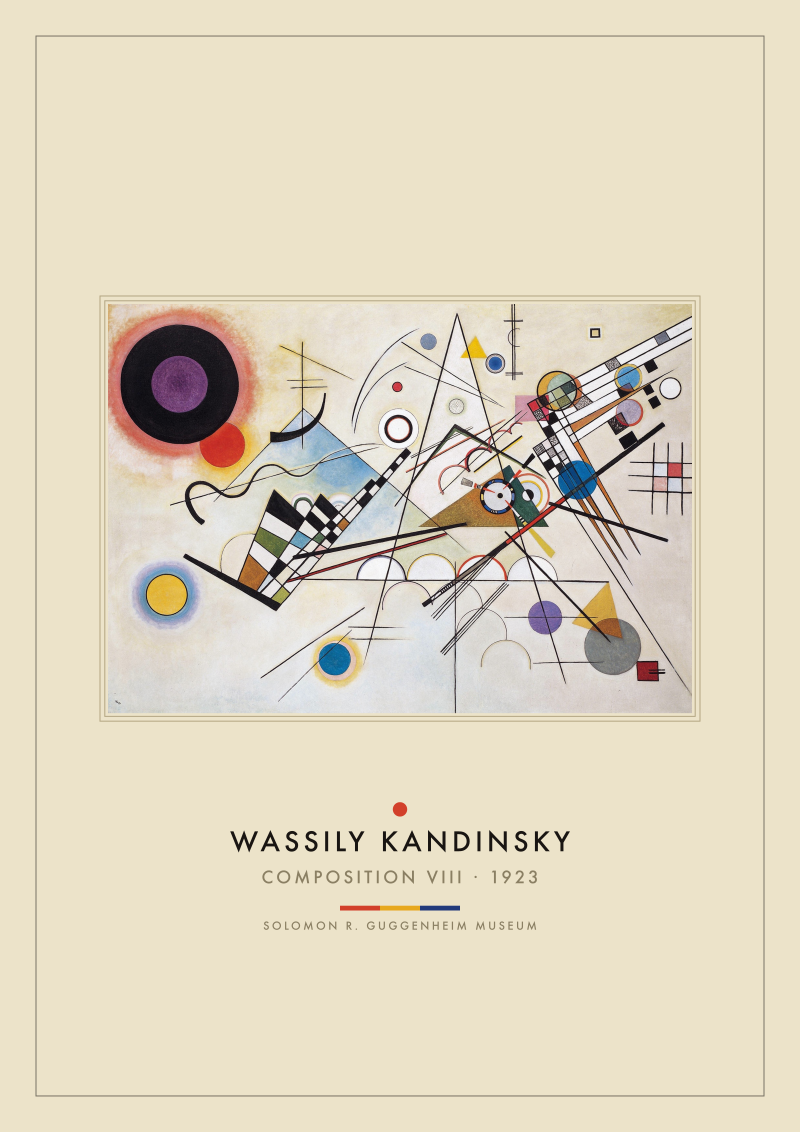
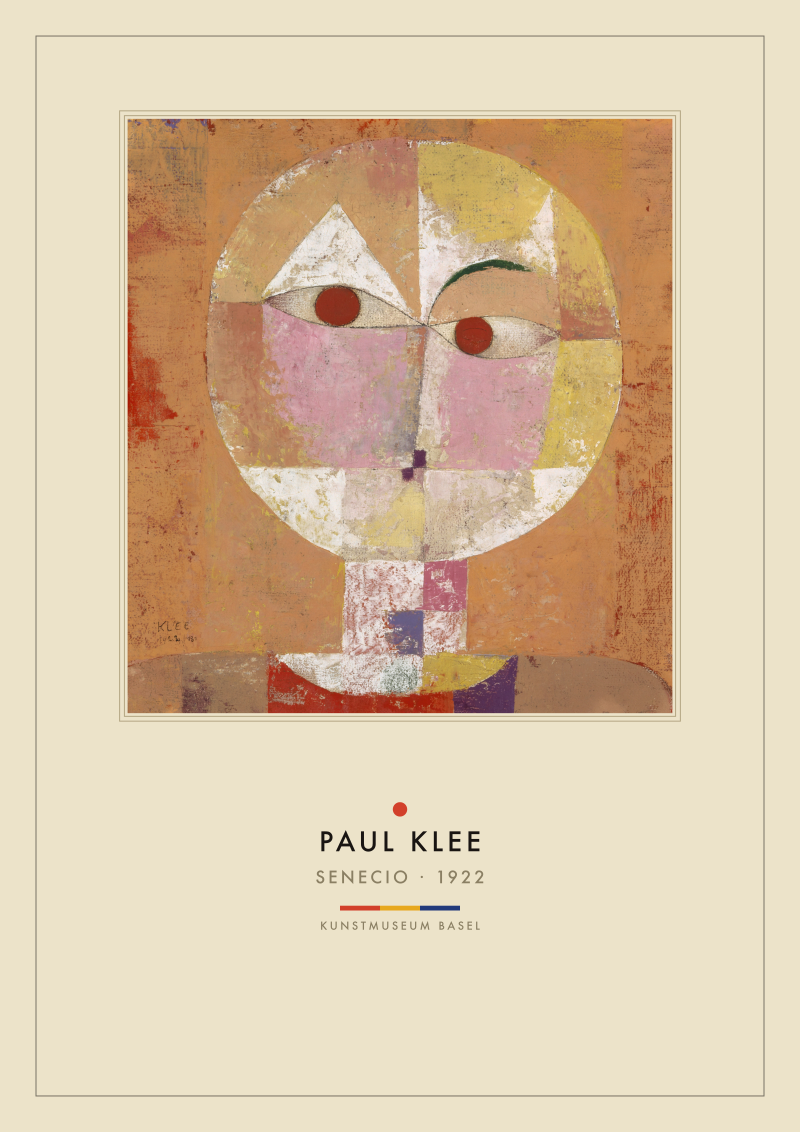
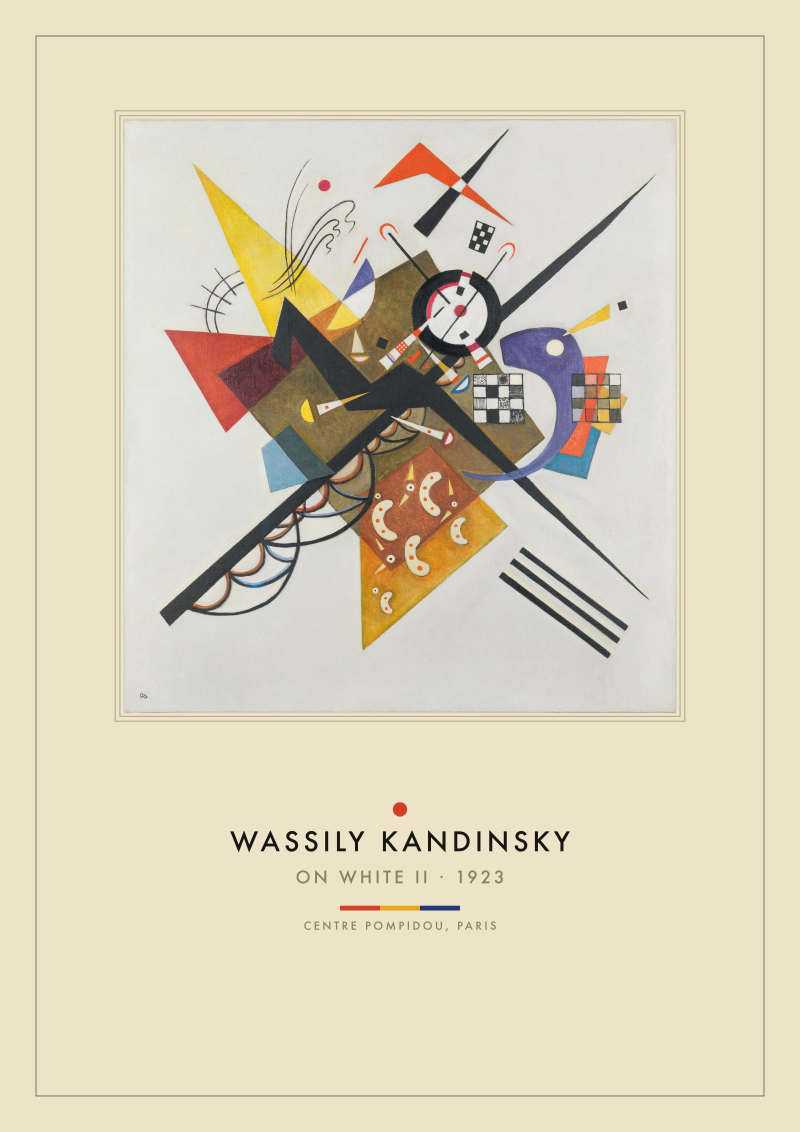
Because the preliminary course was itself an exercise in producing new compositions from a small set of principles, not in copying existing ones. Working from a deterministic seed lets us extend the practice rather than reproduce the archive, and it keeps every piece a first edition of itself rather than a print of a print. The lineage is the method — geometric abstraction reasoned from shape, colour and proportion — not the reprinting of a Kandinsky or a Klee.
If a room fails all three tests, is there no right answer?
There is always a right answer, but sometimes the honest one is that the wall in question is not the right wall. A room with a short sightline, a busy ceiling and no rhythm of its own can host Weimar Drift comfortably, but the piece will do less work there than it would on a wall with clearer conditions. When every signal is muddled, the useful next step is often to reconsider which wall in the room is being asked to carry the composition, not which composition to hang.
From the collection
New compositions and 10% off your first print.
One email now with your code. No noise after.